



- Effigy Bodies Part One: The Pattern & Materials
- Effigy Bodies Part Two: Cutting & Sewing
- Effigy Bodies Part Three: Boning & Binding
- Effigy Bodies Part Four: Eyelets & Lacing
- Effigy Bodies Part Five: The Finished Product
Without further ado, I present my reconstruction of Elizabeth I’s bodies, side by side with the original effigy bodies in Westminster Abbey:


Some close ups of the bodies when mounted on an inflatable mannequin:


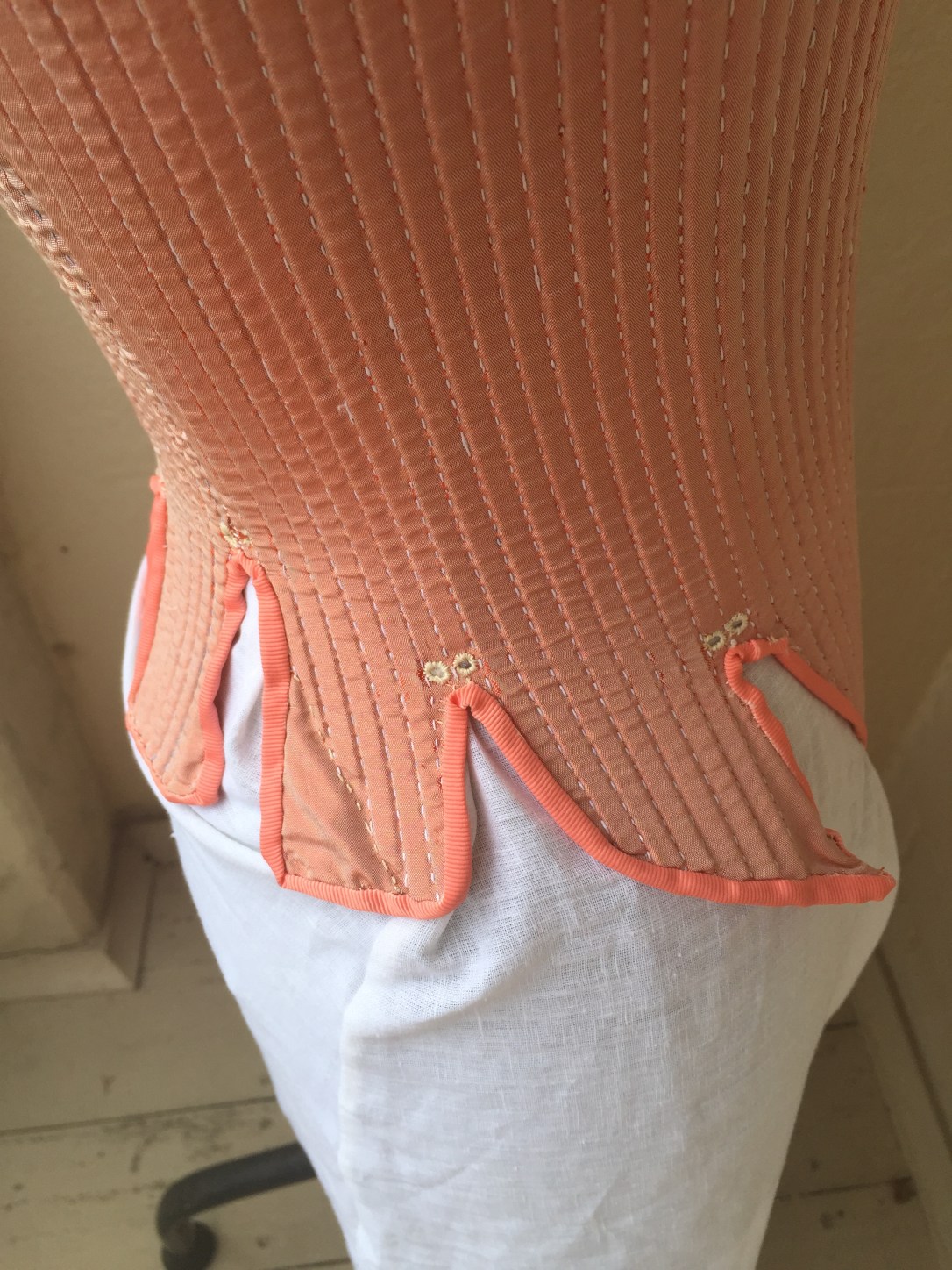

The completed bodies, when on an inflatable mannequin that is small enough to fit them, measure:
Bust: 71.5cm / 28″
Waist: 55cm / 21.5″
Or roughly the equivalent of a AU/UK size 4 / US size 0 / Euro size 32… or in other words: TINY!
Afterthoughts
There are many things I would change if I were to make these again, many of which I’ve mentioned in my previous blog posts, but I’ll outline the most important here. Firstly, I would have used a linen as a lining for the bodies, as besides the fustian used in the original, this is what was most commonly used in other seventeenth century examples. Anne of Demark’s wardrobe records show that she preferred her bodies to be lined with taffeta, which is why my option to use it is historically justifiable. However, with that said I haven’t noticed any disadvantage in terms of fabric strength or durability (so far) to using taffeta. Yet, lining the bodies, which sit so close to the human body which perspires, with a fabric like linen would be the better choice for a garment intended for daily use.
I would also have sewn the bodies entirely in silk thread, and used a back stitch for all the boning channels, not a running stitch (as the original have) and then a half-back stitch as I ended up doing for the last panel.

Some of the readers of this blog have asked why I chose to use plastic whalebone instead of more period accurate materials like bents or cane. For my location and my budget, bents (a type of reed) were far too hard to source. Cane can be quite large and round or thick, and would not have been small enough to replicate the 6mm wide boning channels of the original. When recreating a later pair of American seventeenth-century stays for Pilgrim Hall in Plymouth, Massachusetts, stay maker Hallie Larkin noted that “These stays would have been extremely difficult to make without the artificial whalebone, wood products cut to 4mm would have a tendency to break or bend especially in the long channels at center front and back.” The thick nature of most available cane means that they also would have taken up much more fabric in the boning channels and therefore shrunk the bodies, more than the 1-2mm deep x 5mm wide plastic boning did. Plastic boning not only replicates the size and shape of the original cut baleen in bodies and stays, but it is flexible, molds to the body after time (as baleen did) and is just generally easier to work with.

Other lovely readers have also informed me of other ways to create the eyelet holes when I don’t have a bodkin. These include using different sized knitting needles to create a hole between the threads without breaking them, or to use a tailor’s awl. I hope to trial both these methods in my reconstruction of the Filmer Bodies c. 1630-50.


Overall I’m extremely happy with how the bodies turned out, considering this was my first time sewing a ‘corset’ of this style and doing it completely by hand. My next step is to find a model with body measurements small enough to fit into the bodies and test ideas of fit and movement.