16th century, Elizabethan, Research, Research Publications

Queen Elizabeth I as Mother, Nurse and Caregiver of the Realm

A portrait of Queen Elizabeth I, depicted in an elaborate gown adorned with pearls and jewels, holding a globe in one hand and a scepter in the other, symbolizing her rule over England and her status as a powerful monarch.

Depicting Elizabeth I as mother of her people featured in many discourses during the Tudor queen’s reign. She had responded to her minister’s inquiries about marriage only days into her first parliament in 1559 by stating that she was content to remain a virgin and ‘a good mother of my Country’ until the time came that she should take a husband.[1] Such sentiments were reiterated by the queen four years later in her response to a petition by the Commons that she marry:

‘And so I assure you all that though after my death you may have many stepdames, yet shall you never have any a more mother than I mean to be unto you all’.[2]

Elizabeth was not the only queen who used motherhood metaphors in her ruling rhetoric. Her sister Mary had also proclaimed that, ‘I cannot tell how naturally a mother loveth her children, for I was never the mother of any; but certainly a prince and governor may as naturally and as earnestly love subjects, as the mother doth’.[3]

Motherhood also featured prominently in the political strategies of Elizabeth’s contemporary, Queen Catherine de’ Medici of France. Katherine Crawford has argued that Catherine ‘staked her political career on being considered above all to be a good mother’.[4] She utilised these positive sentiments to construct political claims for herself and to ‘alter several constitutional and ceremonial traditions of the French monarchy’.[5]

Susan Broomhall has also argued that Catherine de’ Medici’s maternal identity as a carer was foregrounded in her management of natural resources, such as tobacco plantations, and her investments in France. Both writings from the queen and those about her, as well as visual and metaphorical representations, framed Catherine’s ‘desire to protect the kingdom as a maternal instinct’ and depicted her investments as charitable labours of love for her people.[6] Indeed, many of Elizabeth I’s acts were framed as ‘tending to the common benefit of the realm’.[7] Like Catherine whose caring identity was expressed in ‘concrete terms of the financial aid that her works provided’, Elizabeth also appears to have authorised crown lands to be leased to the projectors during her reign.[8]

A historical portrait of a woman wearing a black dress and a black veil, with a white ruffled collar, depicting a serious expression.
François Clouet, Portrait of Catherine de’ Medici, c. 1560

Crown Lands and forests has been used by generations of English sovereigns to generate royal revenue via leasing out these lands to fee farms, charging rent and other taxes.[9] Crown lands were also used as forms of patronage to reward loyal subjects and under the Tudors it was common for lands to be bestowed upon favourites. However, as Katherine S. H. Wyndham has argued, in contrast to those before her Elizabeth ‘gave away hardly any land at all’ and her government ‘was not prepared to ignore what Lord Keeper Bacon described in his speech to the 1559 parliament as the “Marvellous decays and wast of the Revenue of the Crown” or at least to forget the long-term significance of whittling away the sources from which a good deal of that revenue accrued-for no return’.[10] Certainly, it appears that among the renewed push for Elizabethan economic ‘projects’ identified by Joan Thirsk, the queen desired to manage her lands more astutely to enrich both royal coffers and the wider English economy.  

While Catherine and Elizabeth both materially invested in acts of care for their people, the nature of their queenship was different. Catherine was a Queen consort, dowager and regent, while Elizabeth was Queen regnant. Elizabeth never had her own biological offspring, while Catherine gave birth to ten children, three of whom became Kings whom she mentored. The realities of Catherine’s motherhood therefore shaped how she was able to draw on this role, particularly as queen regent to her son Charles IX and then as queen mother. It was during her time as queen mother that she expressed the ‘strong desire to be a mother to all your [her son’s] subjects’.[11] This is something which Denis Crouzet has argued linked ‘diplomatic practice with feminine identity’ and linked Catherine’s identity as mother of a king to a ‘motherly figure who protects her son’s subjects’.[12]

Although Elizabeth had no biological children, this did not inhibit her ability to draw on such a metaphor. This is because mothering, as Kristen L. Geaman and Theresa Earenfight have argued, ‘was a socially constructed activity which allowed both childless women and men to participate in maternal practices such as spiritual and nurturing motherhood’.[13] By refusing to marry and have biological children Elizabeth framed herself as a wife to England and mother of its people. In the same year that she declared herself a good mother of England, she is also recorded as telling the commons, while displaying her coronation ring, that ‘I am already bound unto an husband, which is the Kingdom of England’ and ‘I have no children: for every one of you, and as many as are English, are my children’.[14] While there are two different versions of the speech with these details omitted or added in both, the queen’s reasoning was that she need not rush to marriage as she was bound to England and its people, in the same way that a wife is bound to her husband and children. As Coch has concluded, by replacing the conventional biological definition of motherhood with a metaphorical one, Elizabeth escaped practical and cultural constraints while developing ‘a powerful model of female public rule’ where she promised ‘constant, self-sacrificing love and implicitly demands, in return, her subjects’ affectionate respect’.[15]

Remaining a virgin allowed Elizabeth to, as Leah Marcus has argued, ‘preserve her independence’ and tap into other ‘fictionalized versions of herself’.[16] Indeed, Elizabeth frequently drew on different gender roles and positions. Aidan Norrie has noted that in the Golden Speech of 1601, she ‘referred to herself variously as king, prince, and queen: switching between roles and genders with ease’.[17] This was done to prove her legitimacy as woman ruler and a sole one at that; a ‘male body politic in concept while a female body natural in practice’ as Levin has argued.[18] It seems that her subjects were also attentive to the metaphorical gendered identities that the queen wrought for herself, as Norton, in his pamphlet about the Revolt of the Northern Earls, also wrote that:

‘The Queens majesty Queen Elizabeth is by al right the sovereign Lady & Mistress of us al, and of you too… Her grace is the most loving mother and Nurse of all her good subjects, to your shame and reproach of unkindnesses I say it. Her highness is the Husband of the commonwealth, married to the Realm, and the same by ceremony of ring as solemnly signified as any common marriage is’[19]

Here Norton constructs a complex metaphor of Elizabeth as both husband and mother. This reconciled early modern ideas of female sovereignty with those of power; the only way that a queen regnant could maintain power in marriage (an arrangement that saw husbands as naturally superior) was also by ‘playing the husband’.[20]

Although Elizabeth and others often referred to her as ‘king’, ‘prince’ or ‘husband’, what they did not do was to label her a ‘father’. This is because fathers and mothers had very different ‘caring’ roles to play. Kings frequently drew on ideals of fatherhood. However, such ideas were often charged more with the ‘rhetoric of authority’ and order that underlay expectations of fathers under patriarchalism, which drew parallels between households and kingdoms headed by fathers and kings who upheld power.[21]  This included keeping other heads of households (that is, men) in line and providing for their families. These stand in contrast to Elizabeth whose status as a mother to England appealed more holistically to general care and employment for all her subjects, including those who were ‘impotent and lame’.[22]

The maternal trope remained a fixture of the queen’s speeches from roughly 1559-1563.[23] However, even after the Queen stopped explicitly calling herself ‘mother’, many continued to frame her as their mother and caregiver. In calls for the queen to deal with the succession issue in 1566, an unnamed MP beseeched her Majesty to consider her ‘princely care and motherly love towards us your servants and children’.[24] In 1569, the English lawyer, politician and playwright Thomas Norton chastised those who had rejected ‘a most gracious Queen our most dear mother, nurse and protectrice’ during the Revolt of the Northern Earls.[25]

Sir Harrington referred to Elizabeth as a royal godmother and this state’s natural mother. In 1578 on a progress in which the Queen sought to cultivate religious and political conformity within the Kingdom, representatives from the City of Norwich welcomed her as ‘My Princess and my peerless Queen, my loving Nurse and Mother’, and then farewelled her with ‘Farewell, oh Queen, farewell, oh Mother dear’.[26] The description of the queen as a ‘nurse’ repeatedly in Norton’s tract and in many others draws attention to the caring qualities that defined mothers and motherhood. It also alludes to wet-nurses and breastfeeding, just as mothers nursed their children with their breast milk the queen nursed and nourished her people via her caregiving acts for the realm.

As previously discussed, the portrayal of Elizabeth as a nurse was common during her reign. Carole Levin has collected many examples of the queen being referred to as such.[27] These were not associations that Elizabeth shied away from. The famous Pelican Portrait of the queen from c.1575, named so due to the pelican jewel that the queen wears, demonstrates this.[28] The pelican symbol connected Elizabeth with her two separate identities: the virgin (the pelican has been connected to the Virgin Mary since at least the time of St Ambrose) and a nursing mother of her people.[29] The pelican was a symbol of motherly love as they were said to pluck their breasts to feed their young in times of famine, just as a mother nurses her infant from her breast.[30] As Susan Doran has succinctly written, the ‘pelican in piety well suited a ruler described by Protestants as the nursing mother of the Church’.[31] The term ‘nurse’ was inherently gendered, as it derives from the Anglo-Norman nourice, meaning a woman who takes care of a child and during the early modern period it was commonly used when referring to those who took on mothering roles, such as wet-nurses who nursed (breastfed) children or nursemaids (nannies).[32]

Portrait of Elizabeth I, Queen of England, dressed in an elaborate red gown with intricate beadwork and adorned with a crown and pearl jewelry, symbolizing her royal status.
Nicholas Hilliard, The Pelican Portrait, Elizabeth I, 1575

Later in the seventeenth century, depicting England as a nursing mother to her people was common in political conversations as breast feeding by English mothers was thought to transmit ‘physical health’, a ‘strong moral character’ and strong sense of national identity to their children.[33] So much emphasis was placed on these ideas in the Stuart period that Rachel Trubowitz has argued that rulers such as James I, Charles I and Oliver Cromwell used the nursing father, a ‘potent, divine image of feminized masculinity’, to cultivate the support and love of their people and even to strengthen arguments for the union of England and Scotland.[34] While it is not the scope of this chapter to determine whether Elizabeth was the genesis of this renewed focus on nursing monarchy in English political thought that was then taken up by the Stuarts, it is certainly a rhetorical device that she used and supported. To look after a child as a real or metaphorical nursing mother, or father, involved real concern for their health and wellbeing.

During the reign of Elizabeth I, letters patent for new industries such as seed oil and even saltpeter were framed around the Queen’s image as a caring and nursing mother to her people; a woman who sought to enrich not only the crown but her people who relied on her for nourishment and protection.


I explore these ideas and more in my new book chapter titled ‘The Soap-makers and the Queen: The Rhetoric of Maternalism in the ‘Oil Affairs’ of Late Sixteenth-Century England’, which examines debates about oil production in England during the 1570s. This chapter is published in the new edited collection: Queens, Queenship, and Natural Resource Management in Premodern Europe, 1400-1800, edited by Susan Broomhall, Clare Davidson (Routledge, 2025).

Cover of the book 'Queens, Queenship, and Natural Resource Management in Premodern Europe, 1400-1800', edited by Susan Broomhall and Clare Davidson, featuring an illuminated manuscript design.

You can find out more about my chapter and others here: https://www.taylorfrancis.com/chapters/edit/10.4324/9781032723068-10/soap-makers-queen-sarah-bendall?context=ubx&refId=86e3b799-e9dd-4c6a-8aac-0113928975d7


References

[1] Christine Coch, ‘“Mother of my Contreye”: Elizabeth I and Tudor Constructions of Motherhood’, English Literary Renaissance 26, no. 3 (1996): 423; Queen Elizabeth I first speech before parliament, February 10, 1559, Version 1, in Leah S. Marcus, Janel Mueller and Mary Beth Rose, eds. Elizabeth I: Collected Works (Chicago: University of Chicago Press, 2000), 58.

[2] Jan 28, 1563, transcribed in Marcus, Mueller and Rose, Elizabeth I, 72.

[3] Quoted in Coch, ‘Elizabeth I and Tudor Constructions of Motherhood’, 424.

[4] Katherine Crawford, ‘Catherine de Medicis and the performance of political motherhood’, Sixteenth Century Journal 31, no. 3 (2000): 657.

[5] Crawford, ‘Catherine de Medicis and the performance of political motherhood’, 653, 672.

[6] Susan Broomhall, The Identities of Catherine de’ Medici (Leiden: Brill, 2021), 263-98.

[7] TNA: SP 12/126, fol.145v.

[8] Broomhall, The Identities of Catherine de’ Medici, 286.

[9] Daniel W. Hollis, ‘The Crown Lands and the Financial Dilemma in Stuart England’, Albion 26, no. 3 (1994): 420–24; Katherine S. H. Wyndham, ‘Crown Land and Royal Patronage in Mid-Sixteenth Century England’, Journal of British Studies 19, No. 2 (1980): 18–34.

[10] Wyndham, ‘Crown Land and Royal Patronage in Mid-Sixteenth Century England’, 33.

[11] Quoted in Denis Crouzet, ‘“A strong desire to be a mother to all your subjects”: A Rhetorical Experiment by Catherine de Medici’, Journal of Medieval and Early Modern Studies 38, no. 1 (2008): 113.

[12] Crouzet, ‘A Rhetorical Experiment by Catherine de Medici’, 113-4.

[13] Kristen L. Geaman and Theresa Earenfight, ‘Neither heir nor spare: Childless queens and the practice of monarchy in pre-modern Europe’, in The Routledge History of Monarchy, eds. Woodacre, Lucinda H.S. Dean, Chris Jones, Zita Rohr and  Russell Martin (London: Routledge, 2019), 521.

[14] Queen Elizabeth I first speech before parliament, February 10, 1559, Version 2, transcribed in Marcus, Mueller and Rose, Elizabeth I, 59.

[15] Coch, ‘Elizabeth I and Tudor Constructions of Motherhood’, 424-25.

[16] Leah Marcus, ‘Shakespeare’s Comic Heroines, Elizabeth I, and the Political Uses of Androgyny’, in Women in the Middle Ages and the Renaissance, ed. Mary Beth Rose (Syracuse: Syracuse University Press, 1986), 138.

[17] Aidan Norrie, ‘Kings’ Stomachs and Concrete Elephants: Gendering Elizabeth I through the Tilbury Speech’, Royal Studies Journal 6, no. 2 (2019): 186.

[18] Carole Levin, The Heart and Stomach of a King: Elizabeth I and the Politics of Sex and Power, Second edition (Philadelphia: University of Pennsylvania Press, 2013), 121.

[19] Thomas Norton, To the Quenes Maiesties poore deceyued subiectes of the north countrey, drawen into rebellion by the Earles of Northumberland and Westmerland (London: 1569), Biijv.

[20] Levin, The Heart and Stomach of a King, 135.

[21] Laura Gowing, Gender Relations in Early Modern England (Edinburgh Gate: Pearson, 2012), 28, 37.

[22] BL: Lansdowne Vol/22, fol. 90.

[23] Allison Machlis Meyer, Telltale Women: Chronicling Gender in Early Modern Historiography (University of Nebraska Press, 2021), 71-2.

[24] T. E. Hartley, Proceedings in the Parliaments of Elizabeth I, vol. 1 (Leicester: Leicester University Press, 1981), 157.

[25] Norton, To the Quenes Maiesties poore deceyued subiectes of the north, Aiiijv.

[26] These examples are cited in Levin, The Heart and Stomach of a King, 87. For more on the 1578 progress see: Dustin M. Neighbours, ‘With My Rulinge’: Agency, Queenship and Political Culture through Royal Progresses in the Reign of Elizabeth I (PhD diss., University of York, 2016), 82-120.

[27] Levin, The Heart and Stomach of a King, 87, 195.

[28] Attributed to Nicholas Hillard, Elizabeth I, ‘The Pelican Portrait’, c. 1575, oil on panel. Walker Art Gallery, WAG 2994.

[29] Susan Doran, ‘Virginity, Divinity and Power: The Portraits of Elizabeth I’ in The Myth of Elizabeth, eds. Susan Doran and Thomas S. Freeman (London: Palgrave, 2003), 178.

[30] Roy Strong, The Elizabethan image: an introduction to English portraiture, 1558 to 1603 (Yale University Press, 2019), 34.

[31] Doran, ‘Virginity, Divinity and Power’, 179.

[32] ‘nourice, n.’ OED Online, Oxford University Press, 2022. https://www.oed.com/view/Entry/128701 (accessed October 07, 2022).

[33] Rachel Trubowitz, Nation and Nurture in Seventeenth-Century English Literature (Oxford: Oxford University Press, 2012), 3-4, 37, 42.

[34] Trubowitz, Nation and Nurture, 94-97.

reconstruction, Research, Research Publications

New Publication + Free Preview

I’m delighted to announce that my new edited volume, Embodied Experiences of Making in Early Modern Europe: Bodies, Gender, and Material Culture, co-edited with Serena Dyer, has been published by Amsterdam University Press.

You can read the foreword and introduction for FREE, here.

This volume focuses on the body of the maker to ask how processes of making, experimenting, experiencing, and reconstructing illuminate early modern assumptions and understandings around manual labour and material life. Answers can be gleaned through both recapturing past skills and knowledge of making and by reconstructing past bodies and bodily experiences using recreative and experimental approaches. In drawing attention to the body, this collection underlines the importance of embodied knowledge and sensory experiences associated with the making practices of historically marginalised groups, such as craftspeople, women, domestic servants, and those who were colonised, to confront biases in the written archive. The history of making is found not only in technological and economic innovations which drove ‘progress’ but also in the hands, minds, and creations of makers themselves.

We have some amazing contributors who cover a wide range of topics. Here is the table of contents:

List of Tables
List of Illustrations
Acknowledgements
Foreword – Evelyn Welch
1. The Bodies of Makers – Sarah A. Bendall and Serena Dyer
PART I: Making and Embodied Knowledge
2. Bodies and Gender Identities in the Making of Silk Fibre in Seventeenth-Century France – Susan Broomhall
3. Bodies and Spices in the Early Modern European, South Asian, and Southeast Asian Worlds – Amanda E. Herbert and Neha Vermani
4. Attending to the Tacit; Or, Knowledge Trickles Upwards – Leonie Hannan
PART II: Re-Making and Embodied Experiences
5. ‘Your Companions Will Teach You’: Makers’ Knowledge in Renaissance Cosmetics Recipes – Jill Burke and Wilson Poon
6. Beautiful Experiments: Reading and Reconstructing Early Modern European Cosmetic Recipes – Erin Griffey with Michél Nieuwoudt
7. Remaking Sixteenth-Century Botanical Woodblocks: Embodied Artisanal Knowledge in Early Modern Woodcutting – Jessie Wei-Hsuan Chen
8. Generating Bodies: Investigating Foundation Garments and Maternity through Making – Sarah A. Bendall and Catriona Fisk
Index

For more information about the book, visit the AUP website.

16th century, Armour, Manuscript / Archival Research, Object Research, Research, Research Publications

Fortuna and virtù: Embodying Classical Concepts in Renaissance Armour

The first half of the sixteenth century was a period dominated by repeated conflicts in Europe. The immense amounts of practical and ceremonial arms and armour that these conflicts required fuelled this so-called golden age of armour production seen in key centres of production such as Milan, Augsburg, and Tyrol. During these times of occupation, particularly during the Italian Wars, armourers like the Negroli family of Milan were commissioned to make many garments for princes such as Charles V, and so these items represent elite ideals of power and glory. Although some scholars have claimed that ‘much of the decoration on arms and armour is simply ornamental’, power dynamics and paradoxes between the genders during the Renaissance were exploited in the decorative processes of etching and embossing to personify key ideas such as bravery, perils, fortune, virtue, and victory, in either male or female forms.[i] These representations were deliberately fashioned to make explicit proclamations about power by noblemen on the battlefield and beyond in sixteenth-century Europe. Two concepts that armour during this century embodied in these wats were those of fortune and virtue.

Dirck Volckertsz Coornhert and Cornelis Bos after Maarten van Heemskerck, The Capture of Francis I by the forces of Charles V during the Battle of Pavia in 1525, c. 1555-56. Amsterdam: Rijksmuseum, RP-P-BI-6603.

During the medieval period Fortuna was potrayed an assistant to God and she stood for the decrepitude of worldly things and expressed a hidden, unknowable order that made men and women powerless to chance without faith. However, by the fifteenth century humanists and political theorists who believed that men could take back control began to conceptualise Fortuna as possessing innate feminine weaknesses. Like women, Fortuna was now a fundamentally unknowable, destructive and unpredictable power, but one that could also be influenced or yield to those who fought with force.[ii] To counteract the unpredictability of Fortuna and take back control over destiny, authors began to articulate the concept of virtù, something that was masculine, rational and ultimately victorious.[iii] Although early humanists stressed that virtus (a morally good force) was an intrinsic value for all rulers as it brought glory and greatness, for Niccolò Machiavelli the concept of virtù was not necessarily concerned with ethics.[iv] Rather it was more dynamic and stood for political and military achievements that were the foundation of flourishing states.[v]

Lady Fortuna and the Wheel of Fortune. From an edition of Boccaccio’s “De Casibus Virorum Illustrium” (Paris, 1467) MSS Hunter 371-372 (V.1.8-9). Image (vol. 1: folio 1r). Credit: Wiki

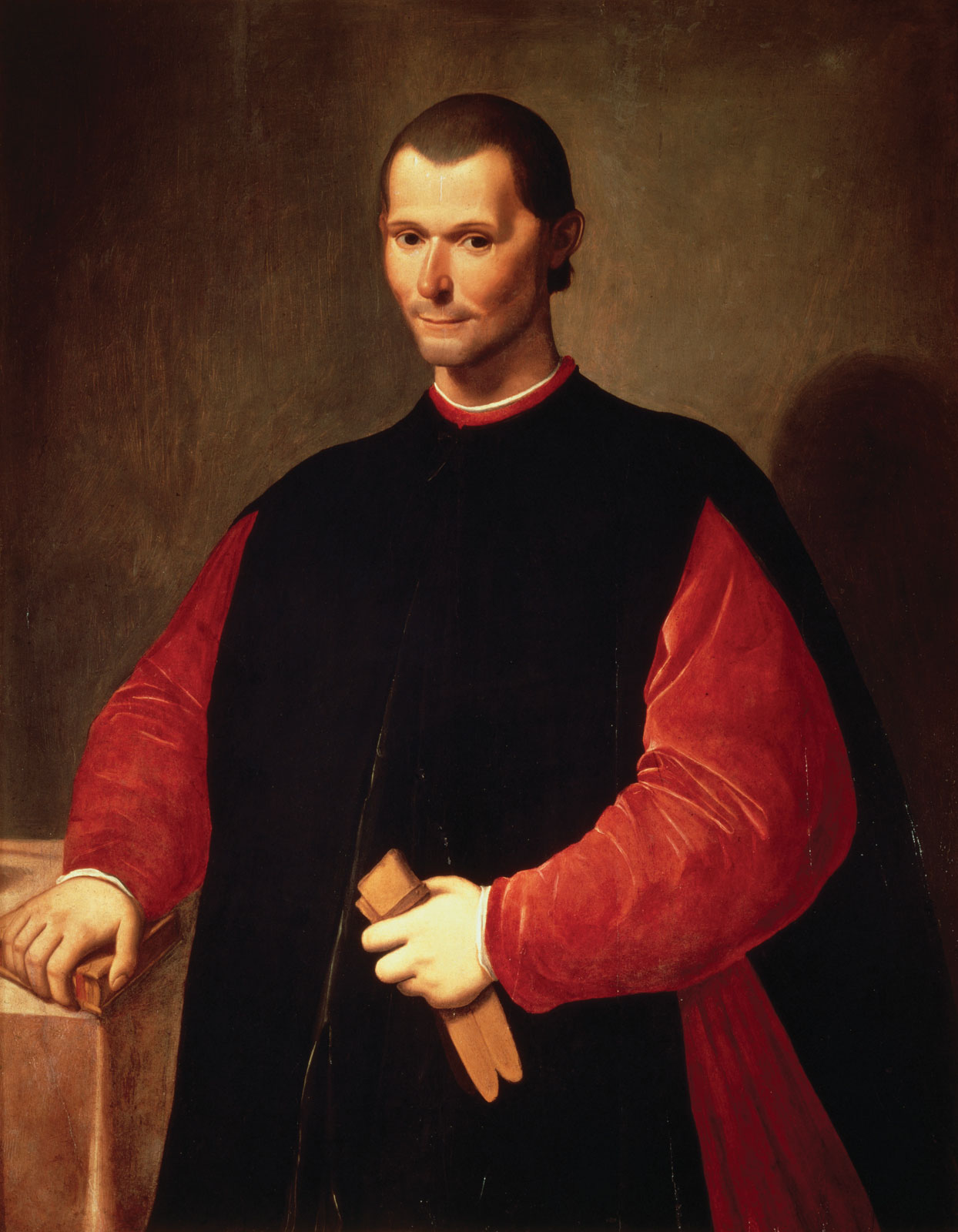
Machiavelli penned his widely circulated work of political philosophy The Prince (1532) in reaction to what he perceived to be the weaknesses of rulers during the Italian Wars. He concluded the work by stating that due to the ‘enormous upheavals that have been observed and are being observed everyday’ it was imperative that men fought to control the whims of Fortuna with ‘ordinata virtù’ (well-ordered virtue) because ‘fortune is a woman, and if you want to keep her under it is necessary to beat her and force her down’.[vi] Machiavelli here echoed the fifteenth-century humanist Aeneas Silvius Piccolomini (Pius II) who after Alfonso V of Aragon’s victory in Naples in the early 1440s imagined the king entering the city and grabbing ‘Fortuna by the scruff of the neck’.[vii] Fortuna’s antithesis Virtù was therefore intrinsically linked to forceful state building and warfare.

Santi di Tito, Portrait of Niccolò Machiavelli, c. second half of sixteenth century. Palazzo Vecchio. Credit: Wiki

These concepts and their gendered power dynamics were increasingly emphasized in political theory, literature, and art during the turmoil of the Italian Wars. The importance of personifying Fortuna as feminine so that she may be overcome by masculine virtù is best exemplified in a portrait medal of French king Francis I from 1537. One side of the portrait medal depicts the king in profile wearing a laurel wreath and holding a staff with a fleur de lis, proclaiming him ‘Francis King of the French’. The reverse side of the medallion shows the king in armour on horseback, arm raised with sword in hand, trampling the naked female figure of Fortuna. The inscription reads ‘He has vanquished fortune through virtue’.[viii] The portrayal of Francis on horseback defeating fortune through virtue is a statement of the King’s tact as a military leader.

Medallion of Francis I – Bust & Allegory, c. 1537, cast iron, Vienna: Kunsthistorisches Museum, 7272b.

As Machiavelli wrote in The Prince, which had been published only five years earlier, it was a prince who had come to power via virtue (here meaning skill and temperament), rather than fortune, who could maintain his principality, as ‘he who relies less upon Fortune has maintained his position best’.[ix] This gendered juxtaposition was therefore a very clear claim about Francis’s masculinity – he was a courageous and brave prince, who won battles for his Kingdom through his reliance on his masculine traits of virtue such as military skill, rather than relying on the feminine whims of fortune.

Similarly, when the concept of fortune was depicted on armour it was always personified as female to remind the wearer of the potential dangers of relying too much on this feminine force. Take for example a shield in the Royal Armoury in Madrid made in 1543 in Augsburg for Prince Phillip (later Phillip II of Spain) by the armorer Mattheus Frauenpreiss.[x] This round shield portrays the semi-nude figure of a woman (Fortuna) holding an oar while attempting to row the vessel. Around her are the words ‘FIDES’ (faith) on a shield, ‘CARO’ (humanity) on the boat, ‘FORTEGA’ (fortitude) on the oar, and ‘GRACIA DEI’ (by the Grace of God) on a box below her knee. There are two possible interpretations of this shield. La Rocca has argued that fortune is depicted as trying to reverse the direction of humanity with the aid of a steering oar and guided by the shield and compass.[xi] This representation of Fortuna appears to take its cues from the medieval understandings as an assistant to God – with faith fortune can be a guiding force.

Jane Clifford, ‘Shield of Phillip II’, photograph c.1865 (London: Victoria and Albert Museum, 47602). © Victoria and Albert Museum, London

However, as with all visual culture, the meaning of this scene is multivalent and it could also warn of the risks of letting Fortuna have too much control over the ship of humanity, as she is facing towards the stern and so does not have control over its movement. The top of the mast also contains a small fool’s cap making this vessel a ‘metaphorical ship of fools’ that is being steered by the unpredictable force that is Fortuna.[xii] The fools here are perhaps those who place their trust in fortune to lead them, rather than those other items on the vessel like the shield of faith. In either case, as La Rocca has proposed, the ‘overall meaning of the shield’s symbolism seems to be intended as a commentary on the misdirection of human folly’.[xiii] The feminine force of Fortuna was considered to play a key role in guiding human fate and potential folly during conflict. It is possible that this shield was gifted to the young Prince Phillip on his wedding day as a salient reminder to the importance of his union to Maria Manuela of Portugal and his role as prince during these troubled times.[xiv]

This acknowledgement of the place of Fortuna in deciding human destiny accounts for other examples of armour and arms that contain her image. A ceremonial breastplate of worked gilded iron gifted to the future Philip III of Spain by Carlo Emmanuelle, Duke of Savoy, now in the Royal Armoury in Madrid, contains the image of Fortuna is framed by winged genii, Justice, Temperance, and other figures, as well as the word ‘SPANIA’.[xv] The piece was made in Italy in the second half of the sixteenth century by an unknown armourer.

Hans Sebald Beham, Fortuna, c. 1641, engraving. Rijksmuseum Amsterdam, RP-P-OB-10.856

Arms from this period also depict Fortuna. A print with a design for a dagger sheath by Hans Holbein the Younger and Hans Lützelburger dating from 1520-1526 shows a woman (Fortuna) in armour standing on a shell with drapery flowing around her.[xvi] In both these examples the symbolic meaning could be two-fold. Authors like Machiavelli stressed that human actions could only be controlled to an extent by virtù, with the rest remaining the domain of Fortuna.[xvii] Therefore, by personifying fortune as Fortuna on armour and arms this practice served to not only remind the wearer of her dangerous influence and acknowledge the part she played in his fate, but in turn, it would also have had the effect of prompting him to remember her antithesis stressed by humanist authors – his own masculine virtù that could overcome her feminine threat.

Filippo Negroli, Helmet all’Antica, c. 1532–35. This piece was possibly a copy of the original in the Kunsthistorisches Museum Vienna. Metropolitan Museum of Art, New York. 04.3.202.

In contrast to Fortuna, virtù was rendered in anthropomorphic forms that transformed the wearer into the vision of masculinity that this concept represented. This is most recognisable in all’antica-style helmets produced by the Milanese armourer Filippo Negroli for Francesco Maria della Rovere the Duke of Urbino, Charles V, and the Gonzagas of Mantua.[xviii] These helmets are sophisticated examples of how embossed armours could literally fashion their wearer into their desired human form. The earliest helmet of this style was forged in 1532 for the Duke of Urbino. It is a burgonet of blackened steel embossed in high relief that forms a head with curly hair and ear lobes, wearing a diadem of twisted palms.[xix] The purpose of this burgonet was to create the likeness of a Roman youth on the wearer, covering his own physical traits and replacing them with those of youth rendered in steel. However, the helmet soon caught the eye of a much more important and powerful patron, Charles V.

A letter sent from the Duke of Mantua to the Duke of Urbino described the Emperor’s interest in Francesco’s recent commission and urged him to send it to the Emperor for inspection. Charles V was so impressed with Urbino’s anthropomorphic helmet that he commissioned his own. It was presented to him on his official visit to Milan in 1533.[xx] The Emperor’s helmet, however, was quite different in form and meaning than that of Urbino’s. It was a full helmet made in two parts of steel and gold. The burgonet was embossed and chiselled by Negroli to create the head of a classical warrior with gold curly hair and earlobes, wearing a laurel wreath. The detachable buffe (lower face defence) contains an additional full beard, lips, and mouth. It is possible that there was also another missing piece of the helmet that created a mask and concealed the face.[xxi]

Filippo Negroli, Classical Roman Burgonet of Charles V, Milanese, c. 1533. Madrid: Royal Armoury, 10000075 – 10000076, D-1; D-2

While both anthropomorphic helmets created classical masculine heads, the differences in the ways that these helmets were gendered male had great implications for expressions of virtù by these Renaissance rulers. While the Duke of Urbino’s helmet and armour depicts a Roman youth at the cusp of manhood and is without personal insignia, the Emperor’s helmet represented a grown Roman man with a full beard. It contains many details that link it explicitly to Charles V such as a collar of the gold fleece with Burgundian fire steels and flaming flints and Charles’s device of PLVS VLTRA with the columns of Hercules.[xxii]

Anthropomorphic helmets and Cuirasses (joined breastplates and backplates) were also embossed to create well-muscled torsos that alluded to men of the ancient world allowed their wearers to literally embody the qualities of virtus and virtù during the conflicts of the sixteenth century.[xxiii] As Carolyn Springer has noted in her discussion of classically-inspired armour, these cuirasses constructed an idealised vision of the ‘elite male body through the process of prosthetic addition’ and they were a form of exclusively male masquerade that enabled the wearer to disguise his own imperfections to achieve the ‘highest model of proportion and physical beauty’ and to represent himself ‘in a heroic and aggrandized mode’.[xxiv] These helmets and torso pieces concealed the wearer’s true form behind a metal façade, allowing him to literally become a classical Roman Emperor who epitomised these values. As Francesco Petrarca advised Niccolò Acciaiuoli in a letter written in the late fifteenth century, to fight back against Fortuna he must become a conqueror and have the ‘moral qualities of a Caesar’, or in other words ‘a man of true manliness’ like those Caesars of the past would overcome Fortuna and attain public glory.[xxv]

Although Charles V commissioned this piece, there is no evidence to indicate that the Emperor dictated its mature appearance.[xxvi] Rather it appears that this was a shrewd political move on behalf of Negroli and Urbino to portray Charles V as he imagined himself to be. Portrait medals struck between 1520 and 1540 celebrated the Holy Roman Emperor as a modern Caesar as they depict him with a laurel wreath on his head and clad in Roman-style armour surrounded by the text ‘IMP. CAES CAROLVS V AVG’, in direct imitation of roman coins.[xxvii] Therefore, the form that this helmet took, whether dictated by Charles himself or others, allowed the Emperor to take that final step in literally embodying his title of a virtuous Caesar.

Joos Gietleughen, Hubert Goltzius, Gillis Coppens van Diest, Portrait of Charles V as Caesar, c. 1559. Amsterdam: Rijksmuseum, BI-2008-4132-148.

This blog post was adapted from an early version of my new research article ‘Female Personifications and Masculine Forms: Gender, Armour and Allegory in the Habsburg-Valois Conflicts of sixteenth-Century Europe’ in which I explore the use of female personifications on sixteenth-century armour made for men between 1525 and 1550. It argues that foreign invading forces and their allies exploited or inverted traditional gender binaries associated with the classical and humanist iconography of the Italian Renaissance, particularly its female allegorical forms, to visually signify power relationships between combatants during the Italian Wars. Rather than simply embodying masculinity, elaborate ceremonial armours with images of women are revealing of both ideals of masculinity and femininity during times of war. These portrayals were part of wider conversations about gender and power, about the strength and weaknesses of women, and, ultimately, women’s inferior status to men, which were utilised in allegorical forms to make claims to authority on these elite forms of male dress.

You can access the article by clicking here.

This research was supported by an Australian Research Council Discovery grant
(DP180102412) held at The University of Western Australia


References

[i] Donald J. LaRocca, Gods of war: Sacred imagery and the decoration of arms and armor (New York: Metropolitan Museum of Art, 2013), 3.

[ii] Arndt Brendecke and Peter Vogt, ‘The Late Fortuna and the Rise of Modernity’ in The End of Fortuna and the Rise of Modernity, (Berlin: Walter de Gruyter, 2017), 2; Corretti, Cellini’s Perseus and Medusa, 68. 

[iii] Brendecke and Vogt, ‘The Late Fortuna and the Rise of Modernity,’ 1-5.

[iv] Quentin Skinner, Visions of Politics: Volume 2, Renaissance Virtues (Cambridge: Cambridge University Press, 2002), 123.

[v] Friedrich Meinecke, Machiavellism: The Doctrine of Raison d’Etat and Its Place in Modern History, trans. Douglas Scott (New York: Praeger, 1965), 31; Skinner, Visions of Politics, 144, 154-6.

[vi] Niccolò Machiavelli, The Prince, trans. and ed. Peter Bondanella (Oxford: Oxford University Press, 2008), 84-87.

[vii] Brendecke and Vogt, ‘The Late Fortuna and the Rise of Modernity,’ 4.

[viii] Medallion of Francis I – Bust & Allegory, c. 1537, cast iron, Vienna: Kunsthistorisches Museum, 7272b.

[ix] Machiavelli, The Prince, 21.

[x] Donald J. LaRocca, ‘Monsters, Heroes, and Fools: A Survey of Embossed Armor in Germany and Austria, ca. 1475 – ca. 1575,’ A farewell to arms, studies on the history of arms and armour, eds. Gert Groenendijk, Piet de Gryse, Dirk Staat, Heleen Bronder (Legermuseum, 2004), 42.

[xi] LaRocca, ‘Monsters, Heroes, and Fools,’ 42; Carolyn Springer, Armour and Masculinity in the Italian Renaissance (Toronto: University of Toronto Press, 2010), 128.

[xii] LaRocca, ‘Monsters, Heroes, and Fools,’ 42.

[xiii] LaRocca, ‘Monsters, Heroes, and Fools,’ 42.

[xiv] Springer, Armour and Masculinity, 128.

[xv] Albert F. Calvert, Spanish Arms and Amour: Being a Historical and Descriptive Account of the Royal Armoury of Madrid (London: John Lane, The Bodley Head, 1907), 131.

[xvi] Hans Holbein the Younger (artist) and Hans Lützelburger (block cutter), Design for a Dagger Sheath, c. 1520-6, print, London: The British Museum, 1895,0122.841-842.

[xvii] Brendecke and Vogt, ‘The Late Fortuna and the Rise of Modernity,’ 5.

[xviii] Silvio Leydi, ‘A History of the Negroli Family,’ in Heroic Armor of the Italian Renaissance: Filippo Negroli and his Contemporaries, eds. Stuart W. Pyhrr and José-A. Godoy (New York: Metropolitan Museum of Art, 1998), 41; Stuart W. Pyhrr and José-A. Godoy, eds. Heroic Armor of the Italian Renaissance: Filippo Negroli and his Contemporaries (New York: Metropolitan Museum of Art, 1998), 119.

[xix] Pyhrr and Godoy, Heroic Armor of the Italian Renaissance, 116.

[xx] Springer, Armour and Masculinity, 105; Leydi, ‘A History of the Negroli Family,’ 41.

[xxi] Álvaro Soler del Campo, The art of power: Royal armor and portraits from Imperial Spain (Sociedad Estatal para la Acción Cultural Exterior, 2009), 48.

[xxii] Pyhrr and Godoy, Heroic Armor of the Italian Renaissance, 125-130.

[xxiii] Pyhrr and Godoy, Heroic Armor of the Italian Renaissance, 14-15.

[xxiv] Springer, Armour and Masculinity, 11, 25, 30.

[xxv] Peter Stacey, Roman Monarchy and the Renaissance Prince (Cambridge: Cambridge University Press, 2007), 143; Skinner, Visions of Politics, 123, 125.

[xxvi] Springer, Armour and Masculinity, 105-106.

[xxvii] Joos Gietleughen, Portrait of Charles V, c. 1559, print, 17.9 x 17.8cm. Amsterdam: Rijksmuseum, BI-2008-4132-148.

17th century, Bodies and Stays, Jacobean, Manuscript / Archival Research, Research Publications, Stuart

The Life and Times of Theophilus Riley: Citizen, Civil War Conspirator and Body-maker.

RP-P-1981-140
Kleermaker (The Tailor), Gillis van Scheyndel (I), 1638. Rijksmuseum Amsterdam, RP-P-1981-140


In 2018 I spent two months in the UK going through records relating to tailors, body-makers, and farthingale-makers at the Bodleian Library in Oxford and the Drapers’ and Clothworker’ Companies in London. While doing my archival research at the Drapers’ Company hall, I mentioned to the archivist Penny that the unusual name of a prolific body-maker, Theophilus Riley, kept popping up in many of my sources. Considering that many of the other makers of bodies (boned-torso garments – the precursors of stays and corsets) were named John, Robert, Henry, Samuel, etc., the name Theophilus was bound to stick out to me.

Penny acknowledged the strange name, noting that she felt like she had read it before but could not recall where. This was until one day she came into the small study room where I was sitting, surrounded by numerous 300-year old hand-bound volumes of company records, and told me that she had remembered where she had heard the name before. A draper called Theophilus Riley had bequeathed a large sum of money and property to the Company in the seventeenth century and, astonishingly, this endowment was still aiding many of the Company’s charitable activities today.

Although Riley was acknowledged as a draper (a dealer in cloth, usually woollen) in the Company’s financial records, and technically he could call himself a draper as he was a member of the Drapers’ Company (by the seventeenth century many members of London’s livery companies did not practice the same profession as their namesake), his actual profession was body-making and a body-selling. Essentially, he was one of the first corset-makers in London.

This made me more determined to find out more about this interesting man’s life. Luckily for me, such an unusual name meant that I was able to track down many records relating to the life of Theophilus Riley – and let’s just say that he was one very interesting fellow!


The Life and Times of Theophilus Riley 

Theophilus Riley was apprenticed under John Smith between 1608 and 1616. Like many members of these livery companies, his origins are obscure as information about his father is missing from apprenticeship records. Upon completion of his apprenticeship Riley quickly set up his own shop in Bow Lane and took on his first apprentice in 1617. Given his political leanings in later life, which I will talk about below, it is possible that he came from a wealthy merchant family in London and this would explain his ability to set up a profitable workshop so soon after finishing his apprenticeship.

thoephilusrileyshop
Circled is the location of one of Riley’s properties in Cheapside.

The 1630s and early 1640s were prosperous for Riley. During the 1630s he took out two leases on properties near Cheapside – London’s shopping street – which were owned by the Drapers’ Company. From 1642-1655 he was a Liveryman in the Drapers Company, a position that also gave him power within the city of London as Liverymen played a key part in electing the city’s sheriffs, mayors, and members of parliament.

Riley’s successful career took place during one of the most troubled times in England’s history. In January of 1642, King Charles I had tried to arrest five leading members of parliament. He feared that they were determined to seize political control and to impeach his French-Catholic wife, Queen Henrietta Maria. When this failed, Charles left London and headed north where he had a strong support base. By August, the king had raised the royal standard at Nottingham, signaling that he considered himself to be at war. In October of 1642, he led his army into battle at Edgehill, the first battle of the wars.

The king’s departure from London in 1642 left the city under the control of his enemies in parliament. At the start of the civil wars Charles’s forces controlled roughly the Midlands, Wales, the West Country and northern England and he established a new court at Oxford. Parliament controlled London, the south-east and East Anglia, as well as the English navy. London was therefore a parliament stronghold and many citizens of the city joined the parliamentarian cause, including Theophilus Riley.

Records reveal that between 1642-3, Riley was a parliamentarian in the Common Council. That same year he was appointed as an ‘assessor for parliamentary subscription and assessments’ and he sat on several important committees such as those that regulated the London Militia and examined ‘malignant, scandalous and seditious ministers.’ By 1643 Riley had become the ‘scoutmaster of the Citie of London’, the chief of the intelligence department of the Parliamentary Army. This meteoric political rise during the tumultuous period of the English Civil Wars as a man who was proclaimed to be ‘of a known & approved Integritie’ and in ‘great esteem with the then Parlament and Citie of London’ soon came to an end though.

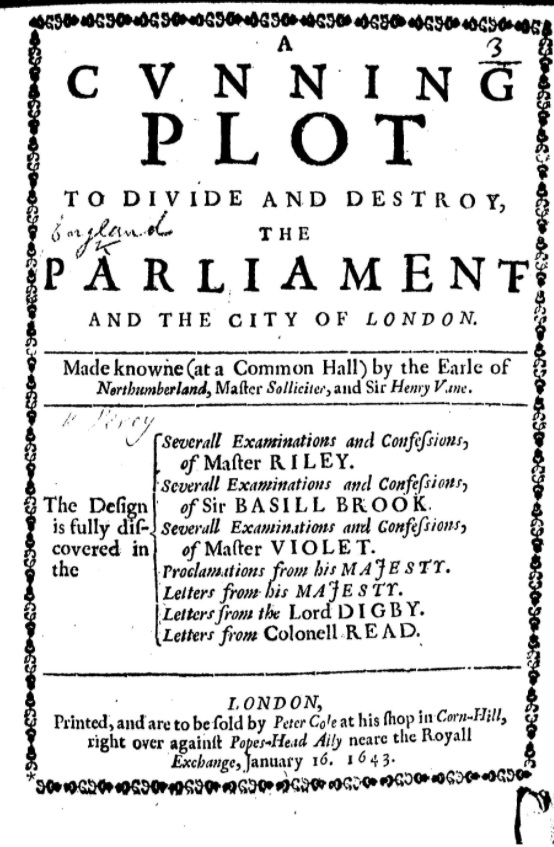
From December 1643 to January 1644 Riley was implicated as a royalist spy in Brooke’s Plot. This was a plot that aimed to divide the City of London by severing the ties between parliament and the influential merchants who funded their war effort, and to broker a peace treaty between the City and the king. This was done with the aim of preventing the Scottish army from taking part in the civil war and to bring about an end to the conflict.[1] Riley’s role as scoutmaster had brought him in contact with royalists Sir Basil Brook and Colonel Read, as well as Thomas Violet, a goldsmith who had been jailed for refusing to pay taxes that funded the parliamentarian war effort. For his part, it appears that Riley had become weary of the war and resented the religious and economic demands of the Scots. Riley, whose code name during the plot was ‘The Man in the Moone’, perhaps taken from a popular tavern called The Half Moon that was close to his shop in Cheapside, oversaw securing releases for the prisoners so that they could travel to the royal court in Oxford. Eventually the plot was discovered, and the conspirators found themselves in the Tower.[2] Riley was released within the year and his estates were not ‘sequestred or taken away’, unlike those of his fellow plotters.

After this scandal it seems that Riley retired as a parliamentarian but remained active in the Drapers’ Company. He is recorded as being of the Livery and Assistants between 1642-64, and he took his last body-making apprentice in 1646. When he died in 1656/7 part of his other property in Bow Lane was left to his wife Elizabeth and their daughter Mary Swift and her children, and the other part to the Masters, Wardens, and Assistants of the Drapers’ Company to hold in trust for his grandchildren until 1686. As well as these properties near Cheapside and Bow Lane, his will also reveals that Riley leased or owned a number of other properties both within and outside the confines of the City walls. The will also left a £600 endowment that stipulated the creation of a trust for apprenticing children of the poor of the Drapers’ Company, which is still active today.


References

[1] J. Rushworth, Mr Rushworth’s Historical Collections from January 1642 to April 1646: abridg’d and improved, Volume 5 (London: 1708), p. 160-2.

[2] A. Percy, A Cunning plot to divide and destroy, the Parliament and the city of London… (London: 1643), pp. 1-12; John Rushworth, Mr Rushworth’s Historical Collections from January 1642 to April 1646, Volume 5 (London: 1708); p. 162; A. Tubb, Thomas Violet, a Sly and Dangerous Fellow: Silver and Spying in Civil War London (Lanham, MD: Rowman and Littlefield, 2017), pp. 44-46.

Parts of this blog post were adapted from my journal article ‘Women’s Dress and the Demise of the Tailoring Monopoly: Farthingale-Makers, Body-Makers and the Changing Textile Marketplace of Seventeenth-Century London’ in Textile History, which is out now! For more information about body-makers and farthingale-makers pre-order my upcoming book Shaping Femininity
15th century, 16th century, 17th century, Bodies and Stays, Busk, Elizabethan, Farthingales, French Farthingale Roll Reconstruction, French Wheel Farthingale Reconstruction, Jacobean, Mantua gown, Manuscript / Archival Research, Research, Research Publications, Seventeenth-century fashion, Stuart, Tailoring

Shaping Femininity Book Cover and Pre-order!

Very excited to announce that my book Shaping Femininity has a cover image and pre-order links! See below for details!

About Shaping Femininity

In sixteenth and seventeenth-century England, the female silhouette underwent a dramatic change. This very structured form, created using garments called bodies and farthingales, existed in various extremes in Western Europe and beyond, in the form of stays, corsets, hoop petticoats and crinolines, right up until the twentieth century. With a nuanced approach that incorporates a stunning array of visual and written sources and drawing on transdisciplinary methodologies, Shaping Femininity explores the relationship between material culture and femininity by examining the lives of a wide range of women, from queens to courtiers, farmer’s wives and servants, uncovering their lost voices and experiences. It reorients discussions about female foundation garments in English and wider European history, arguing that these objects of material culture began to shape and define changing notions of the feminine bodily ideal, social status, sexuality and modesty in the early modern period, influencing enduring Western notions of femininity.

Beautifully illustrated in full colour throughout, Shaping Femininity is the first large-scale exploration of the materiality, production, consumption and meanings of women’s foundation garments in sixteenth and seventeenth-century England. It offers a fascinating insight into dress and fashion in the early modern period, and offers much of value to all those interested in the history of early modern women and gender, material culture and consumption, and the history of the body, as well as curators and reconstructors.


Table of Contents

Acknowledgements
Notes to the Reader
Abbreviations

Introduction: Investigating the structured female body
1. The foundations of the body: foundation garments and the early modern female silhouette
2. The artificial body: courtiers, gentlewomen and disputed visions of femininity, 1560-1650
3. The socially mobile body: consumption of foundation garments by middling and common women, 1560 – 1650
4. The body makers: making and buying foundation garments in early modern England
5. The everyday body: assumptions, tropes and the lived experience
6. The sexual body: eroticism, reproduction and control
7. The respectable body: rising consumption and the changing sensibilities of late seventeenth-and early eighteenth-century England
Conclusion: legacies and misconceptions

Glossary
Notes
Selected Bibliography
List of Illustrations
Index


Pre-Order:

USA/CAN: https://www.bloomsbury.com/us/shaping-femininity-9781350164109/

UK: https://www.bloomsbury.com/uk/shaping-femininity-9781350164109/

AUS/NZ: https://www.bloomsbury.com/au/shaping-femininity-9781350164109/

EUROPE: It should be available via Amazon and all good online book retailers.

EVERYWHERE ELSE: Also available soon for pre-order from all good online book retailers.


16th century, 17th century, Bodies and Stays, Busk, Jacobean, Object Research, Research, Research Publications, Stuart

Seventeenth-Century Busks, Courtship and Sexual Desire

In 2014 my article on this subject was published by Gender & History and a subsequent blog post titled, ‘“He shall not haue so much as a buske-point from thee”: Examining notions of Gender through the lens of Material Culture’ was posted on the blog for the Journal for the History of Ideas. I figured that it was about time that I reproduced that original blog post based on my article. So here it is!


“He shall not haue so much as a buske-point from thee”: Busks, Busk-Points, Courtship and Sexual Desire in Early Modern Europe


Fig. 5
French Busk, Metropolitan Museum of Art, New York, 30.135.34

Our everyday lives are surrounded by objects. Some are mundane tools that help us with daily tasks, others are sentimental items that carry emotions and memories, and others again are used to display achievements, wealth and social status. Importantly, many of these objects are gendered and their continued use in various different ways helps to mould and solidify Identities, sexualities and sexual practices.

In the early modern period two objects of dress that shaped and reinforced gender norms were the busk, a long piece of wood, metal, whalebone or horn that was placed into a channel in the front of the bodies or stays (corsets), and the busk-point, a small piece of ribbon that secured the busk in place. During the sixteenth and seventeenth centuries these accessories to female dress helped to not only shape expressions of love and sexual desire, but also shaped the acceptable gendered boundaries of those expressions.

Busks were practical objects that existed to keep the female posture erect, to emphasize the fullness of the breasts and to keep the stomach flat. These uses were derived from their function in European court dress that complimented elite ideas of femininity; most notably good breeding that was reflected in an upright posture and controlled bodily movement. However, during the seventeenth century, and increasingly over eighteenth and nineteenth centuries, lovers not only charged busks and busk-points with erotic connotations but also saw them as tokens of affection. Thus, they became part of the complex social and gendered performance of courtship and marriage.

The sheer number of surviving busks that contain inscriptions associated with love indicate that busk giving during courtship must have been a normal and commonly practised act in early modern England and France. A surviving English wooden busk in the Victoria and Albert Museum contains symbolic engravings, the date of gifting, 1675, and a Biblical reference. On the other side of the busk is an inscription referencing the Biblical Isaac’s love for his wife, which reads: “WONC A QVSHON I WAS ASKED WHICH MAD ME RETVRN THESE ANSVRS THAT ISAAC LOVFED RABEKAH HIS WIFE AND WHY MAY NOT I LOVE FRANSYS”.

wooden busk English 17th cetury v&a
English wooden Stay Busk, c.1675, Victoria and Albert Museum, London. W.56-1929

Another inscription on one seventeenth-century French busk exclaims “Until Goodbye, My Fire is Pure, Love is United”. Three engravings correspond with each line: a tear falling onto a barren field, two hearts appearing in that field and finally a house that the couple would share together in marriage with two hearts floating above it.

Inscriptions found on other surviving busks go beyond speaking on behalf of the lover, and actually speak on behalf of busks themselves, giving these inanimate objects voices of their own. Another seventeenth-century French busk, engraved with a man’s portrait declares:

“He enjoys sweet sighs, this lover
Who would very much like to take my place”

This inscription shows the busk’s anthropomorphized awareness of the prized place that it held so close to the female body. John Marston’s The scourge of villanie Three bookes of satyres (1598, p. F6r-v) expressed similar sentiments with the character Saturio wishing himself his lover’s busk so that he “might sweetly lie, and softly luske Betweene her pappes, then must he haue an eye At eyther end, that freely might discry Both hills [breasts] and dales [groin].”

Although the busk’s intimate association with the female body was exploited in both erotic literature and bawdy jokes, the busk itself also took on phallic connotations. The narrator of Alexander Pope’s Rape of the Lock (1712, p. 12) describes the Baron with an ‘altar’ built by love. On this altar “lay the Sword-knot Sylvia’s Hands had sown, With Flavia’s Busk that oft had rapp’d his own …” Here “His own [busk]” evokes his erection that Flavia’s busk had often brushed against during their love making. Therefore, in the context of gift giving the busk also acted as an extension of the male lover: it was an expression of his male sexual desire in its most powerful and virile form that was then worn privately on the female body.

Early modern masculinity was a competitive performance and in a society where social structure and stability centred on the patriarchal household, young men found courtship possibly one of the most important events of their life – one which tested their character and their masculine ability to woo and marry. In this context, the act of giving a busk was a masculine act, which asserted not only a young man’s prowess, but his ability to secure a respectable place in society with a household.

Yet the inscriptions on surviving busks and literary sources that describe them often to do not account for the female experience of courtship and marriage. Although women usually took on the submissive role in gift giving, being the recipient of love tokens such as busks did not render them completely passive. Courtship encouraged female responses as it created a discursive space in which women were free to express themselves. Women could choose to accept or reject a potential suitor’s gift, giving her significant agency in the process of courtship. Within the gift-giving framework choosing to place a masculine sexual token so close to her body also led to a very intimate female gesture.

A woman’s desire for a male suitor could also take on much more active expressions as various sources describe women giving men their busk-points. When the character Jane in Thomas Dekker’s The Shoemaker’s Holiday (1600) discovers that the husband she thought dead is still alive, she abandons her new beau who tells her that “he [her old husband] shall not haue so much as a buske-point from thee”, alluding to women’s habit of giving busk-points as signs of affection and promise. John Marston’s The Malcontent (1603) describes a similar situation when the Maquerelle warns her ladies “look to your busk-points, if not chastely, yet charily: be sure the door be bolted.” In effect she is warning these girls to keep their doors shut and not give their busk-points away to lovers as keepsakes.

To some, the expression of female sexual desire by such means seems oddly out of place in a society where strict cultural and social practices policed women’s agency. Indeed, discussions of busks and busk-points provoked a rich dialogue concerning femininity and gender in early modern England. Throughout the sixteenth and seventeenth centuries, bodies (corsets) elongated the torso, until the part of the bodie that contained the busk reached to the lady’s “Honor” (Randle Holme, The Academy of Armory and Blazon…., p. 94) In other words, the lowest part of the busk which contained the ‘busk-point’ sat over a woman’s sexual organs where chastity determined her honour. The politics involved in female honour and busk-points are expressed in the previously discussed scene from The Malcontent: busk-points functioned as both gifts and sexual tokens and this is highlighted by the Maquerelle’s pleas for the girls to look to them ‘chastely’.

13717486_10157141696510392_4553903368644245883_o
To read a tutorial on how I made my own busk click here!

As a result of the intimate position of the busk and busk-point on the female body these objects were frequently discussed in relation to women’s sexuality and their sexual honour. Some moralising commentaries blamed busks for concealing illegitimate pregnancies and causing abortions. Others associated busks with prostitutes, and rendered them a key part of the profession’s contraceptive arsenal. Yet much popular literature and the inscriptions on the busks themselves rarely depict those women who wore them as ‘whores’. Instead these conflicting ideas of the busk and busk-points found in sources from this period in fact mirror the contradictory ideas and fears that early moderns held about women’s sexuality. When used in a sexual context outside of marriage these objects were controversial as they were perceived as aiding unmarried women’s unacceptable forward expressions of sexual desire. However, receiving busks and giving away busk-points in the context of courtship and marriage was an acceptable way for a woman to express her desire precisely because it occurred in a context that society and social norms could regulate, and this desire would eventually be consummated within the acceptable confines of marriage.

Busks and busk-points are just two examples of the ways in which the examination of material culture can help the historian to tap into historical ideas of femininity and masculinity, and the ways in which notions of gender were imbued in, circulated and expressed through the use of objects in everyday life in early modern Europe. Although controversial at times, busk and busk-points were items of clothing that aided widely accepted expressions of male and female sexual desire through the acts of giving, receiving and wearing. Ultimately, discussions of these objects and their varied meanings highlight not only the ways in which sexuality occupied a precarious space in early modern England, but how material culture such as clothing was an essential part of regulating gender norms.


Interested in reading more? You can read my original article in Gender & History here. I will also be talking much more about busks in my forthcoming book, Shaping Femininity
Manuscript / Archival Research, Object Research, Research Publications

The best places to obtain Early Modern Images for use in Publications

RP-P-OB-11.583.editMost people do not realise (until they must go through the process) that sourcing rights and permissions for images to use in publications can be a tedious and very expensive process.

I am currently sourcing images for my book and other projects, and I recently had an email from my colleague asking where to get free or discounted images for use in publications. I decided to compile a list of the institutions and agencies who I have used to get images and my thoughts on them.

Before you read my list you must check out Hilary Davidson’s (aka FourRedShoes) blog – Free Academic Images– to search by continent for any institution that I may have missed and their terms and conditions.

I also need to point out that you must check with some of these institutions whether they consider your publisher to be non-commercial or commercial. Some will allow free image use for works published by a University Press or non-for-profit, while other well-respected academic publishers are considered “commercial” and may incur a fee.

Note that as I’m an early modernist, this list mainly pertains to that field and to artworks that are very much out of copyright.

Also: ALWAYS ASK FOR A DISCOUNT. Whether it be because you are placing a bulk order, you are a student, ECR or independent researcher, always ask! Be shameless – you’ll be surprised by how many places will give you a discount or even give you the image for free!


FREE ACADEMIC IMAGES*

* under certain conditions, check terms of use:

  1. Rijksmuseum– the very best in my opinion. Easy to use. You can download from the image/object entry page or contact their helpful image service to get 300 dpi files via transfer, can publish in anything for any reason. They have a lot of English print material.
  2. Metropolitan Museum of Art (MET) – also great and easy to download off the website. Can publish in anything for any reason. NOTE: Not all images are 300 dpi, so you may need to convert them in photoshop.
  3. Los Angeles County Museum of Art (LACMA) – Easy to use, download off the image/object entry page.
  4. National Gallery of Victoria (NGV) – Easy to use, download off the image/object entry page.
  5. National Gallery of Art, Washington DC – Easy to use, download off the image/object entry page.
  6. Wellcome collection – Easy to use, download off the image/object entry page.
  7. Getty Museum – Easy to use, download off the image/object entry page.
  8. The Royal Collection Trust UK– free for most academic publications, permission needs to be granted via contacting their permissions team.
  9. The Folger Shakespeare Library – free for online blogs and websites with a share-a-like licence. For publications with UPs and most academic journals fees are waived, “commercial” publishers incur a fee. Obtaining publication-quality versions of the images incurs a small processing fee.
  10. Victoria & Albert Museum (V&A)– free for publications with UPs and most academic journals, check first. Need to pay more to obtain digital rights of more than 4 years.
  11. Cleveland: Cleveland Museum of Art– Easy to use, download off the image/object entry page.
  12. Kunstmuseum Basel – Easy to use, download off the image/object entry page.
  13. The Clark– Easy to use, download off the image/object entry page.
  14. National Portrait Gallery, London (NPG) – free for most scholarly article publications under a certain run, not free for monographs. Service is easy to use, create an account and add the image to your trolley.
  15. Fitzwilliam Museum Cambridge – staff are very helpful, they waived the fee for me because I was a postgrad student.
  16. The Walters Art Museum – Easy to use, download off the image/object entry page.
  17. Art Institute of Chicago– Easy to use, download off the image/object entry page.
  18. New York Public Library – Many of the images in their collection are out of copyright and Open access. Under the image look for the green box with download options and “Free to use without restriction”.
  19. Gallica Bibliothèque – The non-commercial use of documents or in an academic or scientific publication (publication produced in the context of university research work) is open and free, provided the source is acknowledged. Download from Gallica or order higher resolution.


Others that I’m less familiar with but colleagues have used with ease:
  1. Newberry Library – no permission fees, prompt and reasonably-priced photography service (thanks Paul Salzman for this recommendation)
  2. J. Paul Getty Museum
  3. The Walters Art Museum, Baltimore
  4. Science History Institute, Philadelphia
  5. Harvard Art Museum
  6. Beinecke at Yale

  7. Thomas Fisher Rare Book Library, University of Toronto

  8. Birmingham AL Museum of Art
  9. Glasgow Special Collections – may waive the fees for reproduction of some images on a case by case basis (thanks to Jan Machielsen for the recommendation)
  10. Nationalmuseum, Stockholm
  11. Nivaagaard Samling, Denmark
  12. National Gallery of Denmark – (thanks to Erika Gaffney for these Scandinavian recommendations)
  13. Harry Ransom Center, University of Texas – free for books with a print run under 2000 copies and journals with a print run under 10k copies (so basically all academic journals). Service fees for new photography and high res files are reasonable, and you can publish your own image too. (Thanks to Aaron T. Pratt for the suggestion).
Other helpful resources:


PAID IMAGE SERVICES:

  1. Alamy– Good selection of varying quality, make sure the images are 300 dpi and the artwork is out of copyright. Make sure to ask for bulk discounts and to get a quote tailored to your publication for maximum savings (ie. small print journals are sometimes covered by their self-publishing licence).
  2. Bridgeman Images – Professional service and great quality. Can be expensive, always ask for a bulk discount!
  3. Photo RMN du Grand Palais – Search the database for images from French collections. Easy to use, create an account and add the image to trolley. Payment is a little annoying (no online payment service), but staff are very helpful.
  4. V&A Image service– Use if your publication is not covered by the free image use policy. Staff are helpful, make sure to ask for a bulk discount!
Providers that I have not used but have been recommended to me:
  1. Getty Images
  2. Scala Archives
Other helpful resources:


I will continue to update this list as I encounter different services. Feel free to comment below with your own suggestions too!

16th century, 17th century, Bodies and Stays, Elizabethan, Farthingales, Jacobean, Research Publications, Stuart

Shaping Femininity – Forthcoming monograph with Bloomsbury

I have recently signed my contract so I am so delighted to announce that my first book based on much of the research that this blog showcases will be published by Bloomsbury Academic/Visual Arts.

Figure 9

Shaping Femininity is the first large-scale study of the materiality, production, consumption and meanings of foundation garments for women in 16th and 17th-century England, when the female silhouette underwent a dramatic change. With a nuanced approach that incorporates transdisciplinary methodologies and a stunning array of visual and written sources, the book reorients discussions about female foundation garments in English and wider European history. It argues that these objects of material culture, such as bodies, busks, farthingales and bum-rolls, shaped understandings of the female body and of beauty, social status, health, sexuality and modesty in early modern England, and thus influenced enduring western notions of femininity.

Beautifully illustrated in full colour throughout, this book offers a fascinating insight into dress and fashion in the early modern period, and offers much of value to all those interested in the history of early modern women and gender, material culture, and the history of the body, as well as curators and reconstructors.

2010EB2907_2500

I’m very excited to be publishing with Bloomsbury and to bring audiences an accessible academic book. At the moment it is early stages, but make sure to keep an eye on this space for more details about release date, etc.

16th century, 17th century, Experimental History, Farthingales, French Farthingale Roll Reconstruction, French Wheel Farthingale Reconstruction, Jacobean, Manuscript / Archival Research, Object Research, Research Publications

The Case of the “French Vardinggale”: A Methodological Approach to Reconstructing and Understanding Ephemeral Garments | New Research Article

0129a17cc8cd74dfb03b1cbb9412bfeedd89ad0e3b
Reconstruction of French Wheel Farthingale, c. 1610s

I’m delighted to announce that my new article was published on Friday! It’s about the experimental reconstructions I did as part of my PhD – some of which are documented here on this very blog. It talks about why historians should engage in experimental reconstruction, and what we can and can’t learn about artisanal knowledge and practices, as well as embodied experiences.

It is part of a bigger special issue in the journal Fashion Theory on the “Making Turn” edited by Professor Peter McNeil (UTS) and Dr Melissa Bellanta (ACU), with editor-in-chief Dr Valerie Steele (FIT NY).

So far, only my article is available on early view. However, if you are interested in historical reconstruction as a research practice, please make sure to check back to the journal over the next few weeks as my colleagues’ papers will also appear. I will link them in this blogpost as they are released:

Now that the article is out I’ll be doing a more layman’s blogpost series about how I made the French wheel farthingale. But if you’d like to read the article please click on the link below to get institutional access. If you don’t have access but would still be interested to read it please get in touch and I will see what I can do!


Abstract:

This article showcases experimental dress reconstruction as a valuable research tool for the historian. It presents a case study detailing how two underskirts of the sixteenth and seventeenth centuries, French Farthingale Rolls and French Wheel Farthingales, were reconstructed using historical techniques and experimental methodologies. The first section outlines my methodological approach to reconstructing these ephemeral garments, exploiting archival and printed records, visual sources, and knowledge of seventeenth-century sewing techniques. The second section focuses on the experience of reconstruction and shows how this process allows the historian to form tacit knowledge. This section also raises questions and provides answers about artisanal design practices such as reflective rationality, embodied experiences, and tacit skills that cannot be accessed in other ways. Finally, this article shows how reconstruction can inform understandings of the embodied experiences of dressing and wearing. Dressing the female body in the reconstructed underskirts discussed in this article made it possible to observe the garments’ practical realities and challenge polemical historical sources concerning fashionable sixteenth- and seventeenth-century European dress.

Keywords: reconstruction, dress, farthingales, experimental dress methodology, embodied knowledge


Publication Details:

https://doi.org/10.1080/1362704X.2019.1603862


Click here to read the Article in Fashion Theory