16th century, 17th century, Elizabeth I Effigy Bodies Reconstruction

Elizabeth I Effigy Bodies Reconstruction | Part Two: Cutting & Sewing


12699304_10156473226030392_1087945436_o

  1. Effigy Bodies Part One: The Pattern & Materials
  2. Effigy Bodies Part Two: Cutting & Sewing
  3. Effigy Bodies Part Three: Boning & Binding
  4. Effigy Bodies Part Four: Eyelets & Lacing
  5. Effigy Bodies Part Five: The Finished Product

After researching the materials that I needed and scaling up the pattern provided by Janet Arnold when she examined the garment in 1994 I then had to cut my pattern pieces. This was done easily and quickly on the grain of the fabric.

12695162_10156472925740392_320469005_o
Pattern pieces (consisting of baking/parchment paper) pinned to fabric, ready to be cut


Once I had my pieces cut I had to work out how to put them together. In Janet Arnold’s analysis of the bodies she noted that the side seams of each sections of the bodies, before they were attached to each other, “were overhanded together from W.S. (wrong side), then pulled very tightly…”[1] In order to be able to do this, when scaling up the pattern I had to allow some extra seam allowance on each piece, as you can see in this photo below:

12699317_10156472938380392_881303468_o
Extra seam allowance can be seen on pattern piece to the far right

With this extra seam allowance, I then I follow Arnold’s instructions and overhanded the pieces together, right sides facing each other (so inside out), from the wrong side, and then pulled them right sides out:

12736701_10156472928490392_1653627607_o
Pattern pieces right sides together, seam allowances folded over.
12698780_10156472944585392_1963318884_o
Over handing seam, pattern piece right sides together.
12669797_10156472944935392_521885924_o
Pattern pieces spread out with overhanded seam visible.
12695308_10156472944875392_1445154397_o (1)
Pattern pieces right sides facing outwards. This is how the seam looks from the right side.

The lining of the back panel was originally done in two parts, possibly to save fabric, so I did this too, allowing extra seam allowance so they could be sewing together via the method outlined above, before being sewn to the outer fabric of the back piece:

12736813_10156472945015392_572010578_o
Centre back lining seam from visible from wrong side of back panel.


It was a this point that I realised that my shot silk taffeta was fraying quite a lot in some areas particularly at the centre front. In order to stop this whilst I handled the pieces to sew in the boning channel I added a very non-historical material, sticky tape, in order to stop it. I carefully removed this later when I bound them.


Historically, in order to achieve the neat straight boning channels seen in surviving bodies from the seventeenth century, the lines of stitching were evenly mapped onto the right side of the fabric with black ink and then this was stitched over. The traditional method of using backstitches would have then covered most of this visible ink.[2] However, the effigy bodies are different in that the boning channels are running stitched, which is far less sturdy a stitch than the backstitching seen in every other historical example from this century. Luca Costigliolo has noted that this was possibly because these bodies “were made quickly for the Queen’s effigy and were never intended for normal wear.”[3]  As my intention was to faithfully recreate most elements of the effigy bodies, I decided to also use running stitches and so did not attempt the ink mapping technique as I knew that the ink outline would be quite visible through the running stitches.

Instead I decided to utilise another early modern technique: pricking. This technique was most employed in embroidery. When a design was bought or drawn, the outline was transferred onto the fabric by laying the paper with the design on top and pricking the paper and fabric underneath with a needle. Then chalk powder inside a cloth bag was “pounced” (dabbed) over the holes, forcing this coloured chalk through the holes and transferring the design.[4]  The Folger Shakespeare library contains a botanical print that had been used to do this as pin pricks are visible on the paper:

Pricked-image-front
Front of plate 20, Crispijn van de Passe, Hortus floridus, 1615. Folger Shakespeare Library, Washington DC
Pricked-image-back
Back of plate 20,  Crispijn van de Passe, Hortus floridus, 1615. Folger Shakespeare Library, Washington DC


As my silk taffeta was a shot silk, when I pricked the fabric, the darker ‘shot’ thread that runs through the fabric became more visible, so pouncing was not needed. For the most part this mark in the fabric is only temporary, so in order to map out my initial boning channels all I had to do was lay down my pattern on top of the pieces and prick the outline of the centre front boning channels through.

Once the outline of the first few had been done, particularly the 13mm (1/2”) wide boning channel at the front, I didn’t need a stencil anymore as each subsequent lines of stitching simply needed to be 6mm (1/4”) parallel to the last. To do this I used a ruler to measure 6mm then made a mark on the fabric with the needle point, then I joined all the points together by running my needle down the fabric, temporarily leaving a line in the shot taffeta that I was able to follow:

12636889_10156473140485392_100312910_o
Mark in fabric made from running point of needle over shot silk taffeta.
12736819_10156473136265392_2015105680_o
Finished front panel, running stitches in linen thread.


Lessons Learnt

Initially I found the process of achieving the tiny running stitches of the original quite hard. At first my stitches were quite big and wide, so I changed to a smaller needle and this improved. Still it is no match for the original, nor for the minute even stitches that I have observed on other seventeenth and eighteenth century garments.

IMG_0681
Tiny stitches on a pair of silk stays c. 1660-1680 that I examined at the Victoria & Albert Museum, London

Hilary Davidson also noted this in her reconstruction of Jane Austen’s Silk Pelisse, noting that because the stitching in the original was not exceptional it “was easy to reproduce the stitching to the same scale, unlike many Regency gowns displaying stitches of an even fineness it takes hundreds of hours of practice for the modern sewer to achieve, especially in muslin.”[5] Pictures of my stitching at the start compared to those at the end do show how much they did improve over the hours I spent doing the reconstruction, however, they do not at all compare to a master tailor or even seamstress who had been hand stitching day in and day out from a young age.

12695134_10156473136210392_1365459528_o
Comparison of running stitching sizes at start (top) and finish (bottom)


After completing the boning channels in the first centre front piece I realised that linen thread, although used in the original effigy pair, was much too heavy for these bodies that are made completely from silk taffeta. For those experienced with using these expensive fabrics and historical threads this is probably common sense. However, I had to learn the hard way. As the point of this reconstruction was not only to test ideas of movement and restriction, but also to learn about production methods, I decided to do one of my panels, the second front panel, entirely in silk thread instead. In all the extant seventeenth century bodies that use silk as an outer fabric, silk thread is used to stitch the boning channels. I also decided to use backstitches instead of running stitches, again to see what difference it would make to the garment.

12736954_10156473146975392_1806952953_o (1)
Difference between running stitch in linen thread (left) and back stitch in silk thread (right)


Immediately after switching threads, I realised that the silk was MUCH easier to sew with and back stitching, as anticipated, was much more secure. I also realise that I probably should have lined these bodies with a more sturdy fabric such as linen, as was done in the rest of the seventeenth century and throughout the eighteenth. Surviving wardrobe accounts from the period do list lightweight fabrics being used to line bodies, sarcenet (a fine soft silk) was a favourite of Queen Elizabeth I. Taffeta was also widely used as Elizabeth’s wardrobe during the same period list: “Item for makinge of a pair of bodies… of black veluett… lined with Taffata…”[6] An inventory taken in 1608 of Anne of Denmark’s wardrobe described: “One payre of Ashcouler cloh of siluer bodies, bound with siluer lace lyned wth carnacon taffeta”[7]   Although these examples do confirm that taffeta was used as a lining fabric at the start of the seventeenth century, it never seems to have been used both as the outer fabric and the lining. There always seems to have been a mix of heavy and light fabrics – such as in the example above where a heavier velvet was used for the outer fabric and taffeta was used for the lining. In many other examples from Elizabeth I wardrobe accounts when taffeta was used for the outer fabric, fustian was used for the lining. When two lighter fabrics were used, such as in the example from Anne of Denmark’s accounts, it is quite possible that these bodies were either more lightly boned or not boned at all.

It will be interesting to see how my finished effigy bodies made entirely of silk taffeta will compare to the next c. 1630s-1650s bodies reconstruction that I intend to make (with my own pattern taken from Dame Filmer’s bodies from the Manchester Galleries) which were made with silk and linen, and that I will make with silk taffeta and linen.

Filmer bodies
Dame Filmer Bodies, c. 1630-1650. Gallery of Costume, Manchester

These are just a few ways in which this reconstruction process is helping me to understand the archival record a bit more  as bodies was quite a generic term and could be used to refer to a corset-like garment or a close fitting kirtle bodice. Once I’ve finished my reconstructions and move to the experimental stage of testing size and movement, it will be interesting to see if these different materials make a difference.

Until then, my experience with boning and binding the bodies will be outlined in my next blog post, so stay tuned!


REFERENCES

[1] Janet Arnold, ‘The ‘pair of straight bodies’ and ‘a pair of drawers’ dating from 1603 which Clothe the Effigy of Queen Elizabeth I in Westminster Abbey’, Costume, Vol. 41 (2007), p. 6.

[2] Luca Costigliolo, ‘From Straight bodies to Stays’, Seventeenth Century Women’s Dress Patterns: Book Two, Susan North and Jenny Tiramani, eds. (London, V&A Publishing, 2012), p. 10.

[3] Luca Costigliolo, ‘From Straight bodies to Stays’, Seventeenth Century Women’s Dress Patterns: Book Two, Susan North and Jenny Tiramani, eds. (London, V&A Publishing, 2012), p. 10.

[4] Melanie Braun, ‘Preparation of the Embroidery’, Seventeenth Century Women’s Dress Patterns: Book Two, Susan North and Jenny Tiramani, eds. (London, V&A Publishing, 2012), p. 56.

[5] Hilary Davidson, Reconstructing Jane Austen’s Silk Pelisse, 1812–1814, in Costume, Vol. 49, No. 2 (2015), p. 210

[6] Elizabeth I Warrant for the Robes, 28 September 1592, ER 34 (PRO LC 5/36), fol. 251.

[7] Cambridge (1607), fol.1, 4.

17th century, Manuscript / Archival Research

Anne Clifford’s Private Purse from Brougham Castle’s Household Expenses, 1675

Cover

Being a history research graduate has a lot of perks – we get to discuss subjects that some might think of as frivolous, we get to pursue our academic interests in an environment where you are supported rather than laughed at (“you’re doing a thesis on corsets, how will that help you get a job?” I had someone ask me once), and well, there are those student discounts.

However, if I had to say what I thought the biggest perk of being a historian was, it’s the documents and the artefacts that we get to view, read and handle. Documents that very few others could ever dream of getting their hands on. It is a little known fact that the University of Sydney has quite an extensive collection of manuscripts and printed works from the medieval and early modern periods in our Rare Books Library. We have the oldest surviving printed European Torah in our collection, we have medieval music books and we also have one of the largest collections of early modern books on demonology, witchcraft and Grimoires.

In this collection we also, randomly, have a household accounts book that dates to the year 1675 and I had the pleasure of studying it in a coursework subject as part of my honours year. This however is no ordinary accounts book. It was an accounts book that belonged to a very well well known English Countess of the Elizabethan and Jacobean eras, Lady Anne Clifford, Countess of Dorset, Pembroke and Montgomery.

Anne CLifford Signature

If you are interested in late Elizabethan and seventeenth century English history, and in particular women’s history during this period, you may have heard of Anne before, in fact, she has been written about many times. This is mainly due to the fact that many of the diaries and letters she wrote during her life have survived, allowing us to take a glimpse into the sometimes very private life of an English noblewoman during the sixteenth and seventeenth centuries in England.

This accounts book is also significant as it provides a glimpse into the running of a seventeenth century English estate. It covers the span one year, gives details for household expenses, wages paid and Anne’s private purse.

Lady Anne Clifford

Anne Clifford was born at Skipton Castle in Yorkshire on 30th January, 1590. She was the only surviving child of George Clifford, 3rd Early of Cumberland and Lady Margaret Russell who was the daughter of Francis Russell, 2nd Earl of Bedford. As a child she was tutored by the poet Samuel Daniel and she was a favourite of Queen Elizabeth I. When she was 15 her father died and left all their estates to his brother, Francis Clifford, 4th Earl of Cumberland. From that moment on and for most of her life she was involved in a struggle to regain her family’s properties which she deemed to be her rightful inheritance. It wasn’t until her Francis Clifford only son Henry died without an heir in 1643 that she managed to secure the estate. By that time she was 53 and had been married twice. First to Richard Sackville, 3rd Earl of Dorset in 1609, two whom she had five children (all three of her sons died). After her first husband’s death in 1624 she later went on to marry Philip Herbert, Earl of Pembroke and Montgomery in 1630.

Via English Heritage

Brougham Castle in located in near the city of Penrith in Cumbria. It was founded in the 13th century by the Norman Robert de Vieuxpont on the site of a Roman fort and at this time it entertained Edward I(Longshanks). Brougham castle’s usefulness diminished after medieval times and by the time it came into the hands of Anne Clifford’s father, George, it was in quite a state of disrepair.

After his death in 1605, and all his estates had been willed to his brother Francis, Anne’s mother Margaret managed to hold onto Brougham castle and started repair work to it. Therefore, Anne spent most of her childhood here. However in 1617 the King granted that Francis was the rightful owner. During the time that it was in Francis’ hands, it entertained James I at an estimated cost of £1,200. It also entertained Charles I in 1629.

The castle again fell into a state of neglect until Anne Clifford finally inherited her estates, however she did not live in it for another six years as the English Civil War was raging and the castle was garrisoned by Cavalier forces. By 1650, after the Civil war had ended, Anne began repairs on the castle. Repairs were mostly complete by 1653, but continued for several years afterwards, the work costing an estimated £40,000.   During her time in the castle in which she made it her country retreat, Lady Anne not only restored much of the castle’s structure, but also the way of life associated with living in a castle, something which is evident from this accounts book which details wages paid, etc.

After her death the castle passed to the Earls of Thanet, when it again fell into a state of disrepair. In 1691 Brougham was partially demolished and finally in 1714, any materials that could be used at the castle were sold off.

A triptych portrait of the Clifford family. Lady Anne is depicted on the left panel, aged 15, and on the right, aged 56 includes her brothers, Francis and Sir Robert. As well as her father George Clifford and mother Margaret Russell; Abbot Hall Art Gallery, Kendal, Cumbria, UK


The Manuscript

The manuscript is plainly bound in vellum. There once was a ribbon attached to tie the covers together and there also used to be red gilding on the pages of the book but this has deteriorated.

For its age the book is surprisingly in good condition even though the bind has deteriorated in some places, and some of the pages are falling out . In the past someone in their wisdom had the idea of sticking newspaper between some of pages. As a result this became stuck to the original manuscript in places.

Damage to Spine

There are two main sets of handwriting in the manuscript. Anne’s in the margins is in scrawly italic script, which looks quite out of place compared to the stylised late seventeenth handwriting of the other person who’s handwriting I could identify: Edward Hazell, Anne’s Steward.

Sir Edward Hasell, born 27/11/1642 in Hildersham, Cambridgeshire. Upon the death of his parents, Edward went to live with his uncle Bishop Rainbow in Cumbria. He was appointed steward (chief secretary) of Lady Anne Clifford in 1668, a position which he maintained until her death in 1676. Upon her death, he was left a large bequest, and using this be purchased Dalemain House in Cumberlandshire in 1680. From there on be became M.P. for the county, and high Sheriff in 1682. He was knighted by William III in 1682 and is listed as helping Wiliam III with his war against France. He died 12/9/1717.

Other pieces of handwriting in the book are those of the servants and people employed at the castle. As they were paid and this was recorded, they were asked to provide their ‘mark’ as proof of payment. Some people’s marks consisted of their signature, for the others who could not write it is simply noted ” ___ ___’s mark’. Surprisingly most of the servants in the household could sign their name, indicating that they must have been literate to some degree.

IMG_1499
Anne’s handwriting far left, Thomas Strickland’s neat stewards writing centre, the servants signatures under each section can be seen clearly

The book is split into two halves, each starting from the different covers. The first section, which I will not discuss in this post, contains the household expenditures of Brougham castle in the year 1675,  whilst the other contains Anne’s personal expenses.


The Private Purse of Lady Anne Clifford

By the time this private purse was written Lady Anne Clifford was well into her eighties. As a result, her personal expenditure on items like clothing or luxury goods is minimal. However, the contents of this section are still very useful in telling us how Anne spent her last year before she died. To get an idea of how much Anne was spending in the equivalent modern currency, I used to website Measuring Worth to find out. As there is no one way to exactly measure the worth of things in the past, as different people and contexts produced a variety of prices for similar items, the Measuring Worth website gives two main indications: RPI, or a Commodity which indicates the present worth of buying an item in terms of spending, and GDP, which calculates how affordable something was based on the average wage or average earnings at the time.

Many of the entries are about money given to people who had provided a service for the Countess. For example she paid the “chaplan for preaching a good sermon”, and gave payment to men who had fetched things for her. However, there are many personal entries that reveal more about the Countess’ personal life. For example, one of the most interesting entries in the section is one that states, “Paid George Goodgion for clipping off all the haires of my head in my chamber at this Brougham castle which I had not done since the 24th September last…” This entry is recorded on the 20th day of October, so not only can we gather how often the countess had a haircut, but who gave it to her and how much she paid him (6 shillings or £38.20 in today’s currency). On a different occasion she also paid George “ffour shillings” for bringing her “a pound of Virginia tobacco”. So we can also gather that she smoked and that this pound of tobacco cost around £25.50 in today’s currency.

For the historian of material culture the best thing about this private purse is that it allows us to see the value of things in the past. For example, two ” ffushion sheets” purchased from the tailor Emannell Jackson for the Countess’ bed cost 2 shillings / £12.70 today. Whilst two pairs of sleeves (I assume for a gown) cost the Countess 4 shillings and 6 pence / £28.60 today, and 14 yards of bone lace cost 5 shillings and 9 pence / £36.60 today.

In this section another large order is placed, this time for all the materials needed to make a complete gown. In this order was “8 yards and a half of cloth serge for a gorone for mee :1:11:2:… ” and “fustian, buckram, canvis gallooz, ferrit ribbon and other thing trimming of it 0:13:6:”. Not only do we have a complete list of everything that was used to make the gown, we also have separate prices for the fabric and the trims! All up these materials are listed as costing 2 pounds, 4 shillings, 8 pence / £284 today. The serge fabric (a lightweight twill fabric with a worsted warp and woollen weft) was £198 for 8 yards, so £24.75 per yard. [1]

Scarlet cloth ordered by Lady Clifford

In October 1675 the Countess paid “3 yards of scarlet cloath hee bought for mee at Kendall at 1:10:p yard: :4:10:0: and for the bayes that it came in :1:6: In all ffour Pounds Eleauen Shillings and Six pence”. In today’s currency this 3 yards of scarlet cloth would be the equivalent of £573 (if we use the RPI on Money Worth). I assume that in this entry the scarlet cloth is referring to the expensive woolen broadcloth fabric (usually coloured red with the expensive kermes dyes) that was common in the medieval and Tudor periods. [2]

It is only by looking at these sorts of figures that you can begin to understand why only the aristocratic classes could afford such exquisite clothing in the past, if three yards of this fabric cost £573 imagine how much a whole tailored dress was, especially since 8 yards of the plain serge fabric mentioned above cost the same as only one metre of this scarlet fabric.

Roughly speaking if a gown used 8 yards of fabric, just the fabric alone for one dress using this scarlet cloth would cost a whopping £1530 in today’s currency (8 x 1 pound:10 shillings per yard, with 20 shillings to a pound = £12 / 8 yards of fabric)!!! That’s over $3000 US/AU for one dress!

However it appears that this fabric wasn’t for personal use as in the margins we learn that the Countess did not intend to keep this cloth as she has remarked “payed for 3 yards of scarlet clothe to give away”. By the end of her life it appears that the countess must have been very charitable as many of the items listed were intended as gifts. One entry states that she “Payed the 13th day to George Goodgion for 30 bookes of devotion hee bought me at Penrith for severall sortes, and different rates which I intend to give away to my servants…” She also gave Robert Bartion (who she has referred to in the margins as ‘Doctor Barton’?) 5 shillings “to buy him a pair of gloves”. This is the equivalent to £31.80 today.

Anne Clifford died in Brougham castle in the same room as her father was born in, on the 22nd March 1676, at the age of 86 – only one year after this accounts book is dated. As a result this accounts book must be one of the last ones ever completed for Brougham castle when it was under Anne’s ownership. What I’ve talked about in this post is just skimming the surface of the amazing information that this manuscript contains, and provides a fascinating glimpse into the everyday life of not only a famous figure in English history, but into the everyday lives of those ordinary people who worked in her estates.


REFERENCES

[1] Ninya Mikaila and Jane Malcolm-Davies, The Tudor tailor: Reconstructing 16th-century Dress (London: Batsford, 2006), p. 37.

[2] Mikaila and Malcolm-Davies, The Tudor tailor, p. 36..


16th century, 17th century, Bodies and Stays, Elizabeth I Effigy Bodies Reconstruction, Elizabethan, Experimental History, Tutorial

Elizabeth I Effigy Bodies Reconstruction | Part One: The Pattern & Materials

ch23a
Elizabeth I effigy bodies, 1603. Westminster Abbey, London
  1. Effigy Bodies Part One: The Pattern & Materials
  2. Effigy Bodies Part Two: Cutting & Sewing
  3. Effigy Bodies Part Three: Boning & Binding
  4. Effigy Bodies Part Four: Eyelets & Lacing
  5. Effigy Bodies Part Five: The Finished Product

The first reconstruction that I will be making is the effigy bodies of Queen Elizabeth I that are now on display in Westminster Abbey in London. These bodies were specially constructed, probably by the Queen’s tailor William Jones, upon the death of Elizabeth in 1603, for the effigy that would accompany her body to its resting place in Westminster Abbey. As Janet Arnold notes, it is therefore unlikely that the Queen ever wore these bodies, however, their size and construction was probably based on the bodies that Jones had previously made for the Queen.[1] Regardless of whether the Queen really did wear them or not, they are the second oldest pair of bodies in Europe that are known to have survived (the earliest surviving bodies were found on the corpse of Pfalzgräfin Dorothea Sabina von Neuburg, who was buried in what is now Germany in 1598), and the certainly oldest English pair that we know of.

The Pattern

The pattern I’m using for my reconstruction is one that the amazing Janet Arnold made of the bodies when she studied them in 1994, which was then published posthumously in the journal of Costume.

The effigy bodies consist of three separate parts: two front sections that lace together with twenty-nine eyelet holes and a back section. The lining consists of four parts (the back panel lining being divided into two sections).[2] There are a total of six tabs that spread over the hips, two on the back piece and two on each front section. From the pictures and the pattern provided I’m unsure as to whether the shoulder straps are part of the back section, or are attached separately. Arnold’s pattern has them as separate from the back piece, however, in the pictures and other sketches of the bodies they appear to cut into the back piece.

Elizabeth I effigy bodies

My intention is the make the bodies exactly the same size as the original pair in Westminster Abbey, which by my calculations means that Elizabeth I had a 21” waist (!!). A disclaimer at the start of the article states that “Janet’s full-scale pattern of the ‘pair of straight bodies’ has been scaled down to fit the page size of Costume.”[3] I, however, am working off a .pdf document version of this article printed on A4 paper which may be bigger than the pages of Costume. Although technically if I copy it correctly onto a 1 inch scale it shouldn’t really matter. To double check this though, I’ve also used the pattern provided in the Tudor Tailor.[4]

Elizabeth I effigy bodies pattern

The Materials

Unlike the bodies mentioned in the wardrobe accounts of Elizabeth I, the effigy bodies are rather plain. They are made from two layers of twill weave fustian cloth that was originally white, are bound by green leather that had a suede finish and were stitched with linen thread.[5]  The term ‘bodies’ during this period could refer to a number of things – from the bodices of gowns, to the undergarment that is visible on Countess Elizabeth Vernon of Southampton in her portrait below, and of course to the effigy bodies.

Elizabeth Vernon, Countess of Southampton, 1595-1600. Unknown Artist. Boughton House

My archival research has confirmed that bodies that belonged to elites during this period were always made from materials such as silk satins and silk taffetas, sometimes even velvet, and usually lined with sarcenet, fustian, canvas or buckram.  Contrary to popular opinion, bodies were not always stiffened with material such as whalebone or bents, and rarely so until the late sixteenth century.

When considering how then I would make my reconstruction, taking into account the effigy bodies, wardrobe warrants and visual evidence such as the portrait of Elizabeth Vernon, an entry in the warrants of Elizabeth I from 1590 caught my eye. It requested:

“Item for makinge of a paire of french bodies of carnacion Taffata Lyned with fustian stiched alouer with whales bone of our greate warderobe.” [6]

Here was a wardrobe account that not only matches the only visual image of elite bodies from the period, but was made within a close enough time period to the effigy pair that they could have been the same or a very similar style.

Therefore, for my reconstruction I will use a pale pink (“carnacion”) coloured silk taffeta for both the outer fabric and the lining. Although fustian and sarcenet were the fabrics most commonly used as lining in the wardrobe accounts, they are rarely used in modern clothing and so are incredibly hard and expensive to source. There are warrants from Elizabeth’s wardrobe during the same period, such as this one: “Item for makinge of a pair of bodies… of black veluett… lined with Taffata…”, that shows that taffeta was also used as lining, although less frequently.[7] To bind the bodies I will use white faux leather which closely mimics the properties of leather and is easy to source.

011093e0533235dc771f2c8bb16fca9b392f2a157d
Modern plastic ‘whalebone’, pink silk taffeta, linen thread

The 1603 effigy bodies are completely boned with whalebone and the average width of this boning is 6mm, except for two 12.7mm wide pieces on either side of the front opening.[8]  As whalebone (‘baleen’) is, for good reason, not available anymore I will have to use an somehing else. A period alternative would be small bundles of bents (a thin reed), like those used in Hilary Davidson’s modern reconstruction of a sixteenth-century Spanish pair of bodies.[9] However, as the effigy bodies contained whalebone I will use a modern alternative that mimics baleen’s properties. I have chosen modern plastic dress making boning. It is similar in width to the original whalebone (5mm) and contains the same amount of flexibility as traditional whalebone.  Although silk bodies probably would have been constructed with a mixture of silk and linen thread, as costs must be considered in my reconstruction, I will use only linen thread to hand construct the bodies and to work the eyelet holes so they don’t fray (similar to the way that modern button holes are done).


References

[1]Janet Arnold, ‘The ‘pair of straight bodies’ and ‘a pair of drawers’ dating from 1603 which Clothe the Effigy of Queen Elizabeth I in Westminster Abbey’, Costume, Vol. 41 (2007), p. 1.

[2] Arnold, ‘The ‘pair of straight bodies’, p. 1; Luca Costigliolo, ‘From Straight bodies to Stays’, Seventeenth Century Women’s Dress Patterns: Book Two, Susan North and Jenny Tiramani, eds. (London, V&A Publishing, 2012), p. 10.

[3] Arnold, ‘The ‘pair of straight bodies’, p. 1

[4] Ninya Mikaila and Jane Malcolm-Davies, The Tudor tailor: Reconstructing 16th-century Dress (London: Batsford, 2006)

[5] Arnold, ‘The ‘pair of straight bodies’, pp. 1, 3; Luca Costigliolo, ‘From Straight bodies to Stays’, p. 10.

[6] Elizabeth I Warrant for the Robes, 18 May 1590, ER 32 (PRO LC 5/36), fol. 133.

[7] Elizabeth I Warrant for the Robes, 28 September 1592, ER 34 (PRO LC 5/36), fol. 251.

[8] Arnold, ‘The ‘pair of straight bodies’, p. 3.

[9] Hilary Davidson and Anna Hodson, ‘Joining forces: the intersection of two replica Garments’, Textiles And Text: Re-Establishing The Links Between Archival And Object-Based Research, [postprints], eds. M. Hayward and E.Kramer, (London: Archetype, 2007), pp. 206-108.

16th century, 17th century, Experimental History

Reconstructing “deform’d” fashions – My Journey into Historical Reconstruction

Elizabeth I effigy bodies, 1603. Westminster Abbey, London

 Reconstruction has until recently not been seen as a concern of the serious academic, relegated to the domain of television, re-enactors or living history museums. Yet reconstruction has been used by archaeologists, curators and conservators for many years, standing in for objects that are too frail to be put on permanent display or adding a “physical depth to present interpretations of now-absent objects.”[1]

Although reconstructing historic items of dress is subjective and is never preferable to historical evidence, through my experience with museum curators, through conversations with students of historical design at the Royal College of Art in London, as well as other scholars in the material studies academic field, I have learnt that reconstructions can help the historian to not only interpret evidence but to understand movement and bodily constraint in regards to past fashions. Ulinka Rublack from the University of Cambridge has incorporated reconstructions into her work on Renaissance fashion. Hilary Davidson has engaged in historical reconstruction for many years during her career as a curator at the Museum of London and in her scholarly work since, helpfully outlining its merits in her most recent article ‘Reconstructing Jane Austen’s Silk Pelise‘. Renown fashion historian and the figure to whom many of us now working in the field owe our gratitude, Janet Arnold, was a pioneer of fact-based faithful reconstructions of historical dress, and institutes such as the School of Historical Dress run by Jenny Tiramani, and publications by Tiramani and Susan North from the Victoria and Albert Museum lead the field in reconstruction in early modern material studies.

When I have given papers I have come across questions about movement and constraint, as audiences try to visualise the reality of these garments from the pictures and textual evidence I have provided. To some extent, these are questions which my extensive archival and historical sources cannot answer with certainty. We may never know exactly how a sixteenth, seventeenth, or eighteenth-century woman felt when she wore these items, nor am I suggesting that we can use reconstructions to accurately recapture bodily experiences from the past. However, I can recreate their materiality to help analyse the primary sources that I already have – such as commentary on their size, on movement and restriction, or the concealment of pregnancy for example.

I have been lucky enough to receive a grant from my university to reconstruct the items that my research examines – a spanish farthingale, a french farthingale, a wheel farthingale, late sixteenth-century bodie, early-mid seventeenth-century bodie, bum rolls and a late seventeenth century bodie.

Materials to be used are those that closest resemble the original materials which I have found in archival records. Baleen for example is not able to be used, but cane or modern dressmaking boning can be. Other fabrics such as linen and silk are readily available, albeit expensive. I am not making these items to learn about the tailoring field or the process of construction, although I will undoubtedly learn a lot about this in the process, I am reconstructing to learn about mobility, movement and space. Patterns used in these reconstructions will be taken from reliable sources such as Janet Arnold’s Patterns of Fashion, Jenny Tiramani and Susan North’s previously mentioned book, and historical patterns. As there are no surviving examples and no surviving patterns for some of the garments, mainly those for French and Wheel Farthingales, some of my reconstructions will be based on descriptions of women wearing them, visual images and educated guesswork as well.

I’m hoping to keep track of my reconstructions on this blog, as sort of an online diary. Please feel free to comment and add any suggestions!


Read

Elizabeth I Effigy Bodies Reconstruction, Parts 1-5


References

[1] Katy O’Neill and Francesca Butcher, ‘The Fashionable accountant – Reconstructing his best outfit’, Victoria and Albert Museum, 24 Novemeber 2014 <http://www.vam.ac.uk/blog/research-department/the-fashionable-accountant-reconstructing-his-best-outfit&gt;

17th century

Looking at 1630s English Fashions through Wenceslaus Hollar’s Ornatvs Mvluebris Anglicanus

In order to understand early modern undergarments, it’s also vital to understand the outergarments that were worn. In order to better educate myself I’ve recently been going through some of the engravings done by seventeenth-century artists, particularly the Bohemian Wenceslaus Hollar who worked extensively in England, and Abraham Bosse, a French engraver. I love, love, love the engraving styles of the early seventeenth century, and particularly the styles of both the artists that I’ve mentioned.

As a historian working on dress these types of engravings are also particularly useful to understand what types of clothing people wore and how they wore it. Although, keep in mind, that as an artistic medium these drawings can be prone to exaggeration or artistic licence. However, for the most part Hollar seems to have liked to draw people from all walks of life and in various social situations, so you can assume that they must have been somewhat realistic representations.

The prints below come from a particular work Ornatvs Mvluebris Anglicanus or The Severall Habits of English Women, from the Nobilitie to the contry Woman, as they are in these times, 1640. Although the British Library also dates some of the pictures to 1638. In all probability, many of these engravings were first sketched in the late 1630s and not published until 1640. There are no captions that accompany the pictures, but they appear to progress from elite dress to common dress and that’s how I’ve ordered the ones below. All of the pictures and more, are available via the University of Toronto’s Wenceslaus Hollar Digital Collection.

 Fashionable Gowns 

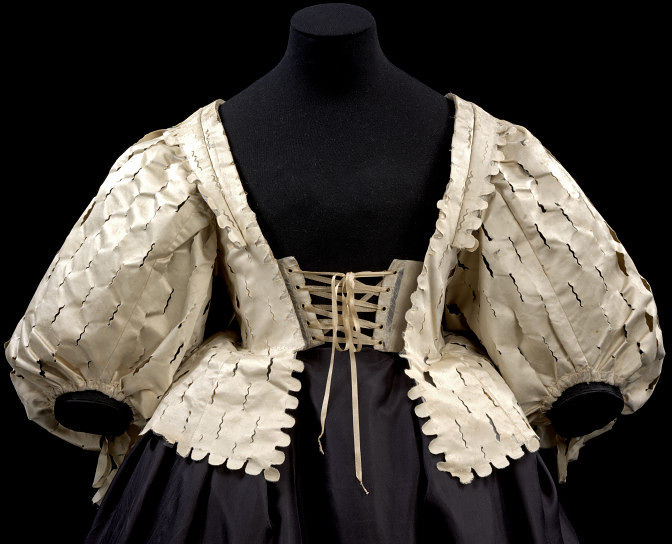
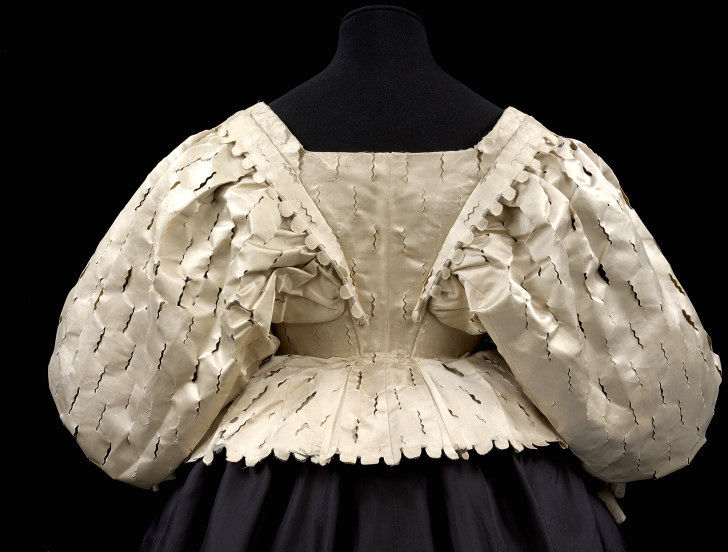
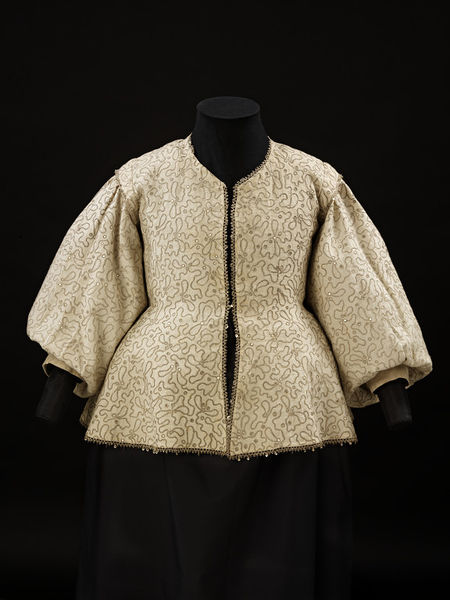
These fashionable elite women both wear the gowns of the 1630s that consisted of bodices with high waistlines and elbow-length full voluminous sleeves, a stomacher, a petticoat skirt and a falling lace collar.  The bodices were often boned, as the extant example from the V&A is below with whalebone, buckram and canvas, and the stomacher would also have been stiffened with heavy fabrics, whalebone or a busk.


Bodice. 1630-1639. England.  Victoria & Albert Museum, London

Although it seems that the bodice of the gown could also be incorporated into the skirts as the picture of the woman on the bottom depicts. A tailoring bill for Queen Henrietta Maria from 1634 mentioned “one Gowne of black satin, The Sleeves, Stomacher and forepart with a lace throughout.”

Women also wore foundational garments underneath such as the bodies and rolls.

Hungerline

A curious case is the ‘hungerline’ or French ‘hongreline’. When I was examining the household bills of Henrietta Maria of England, I came across numerous references to a “hungerline”, for example in a bill from 1632 it states that the Queen’s tailor made a “Satten hungerline imbrodered with gold and Silver sticht and garnished with whalebone and lyned with taffaty.” The bill also makes references to an un-boned “carnacion satten hungerline imbroidered and stitched and lyned with white taffetie…”

So it left me wondering – what is a hungerline?

According to French sources, a ‘hongreline” was a short French-style waistcoat that was derived in style from the justaucorps which was a coat worn by men (by 1690 it was described in Antoine Furetière’s dictionary as a short-sleeved shirt with large tabs). Alfred Franklin in Corporations ouvrières de Paris Du Douzième Au Dix-Huitième Siècle (1884) noted that it was common among rural women and servants in France. However, considering there is ample evidence of it in Henrietta Maria’s wardrobe  and it is depicted on bourgeois women (see below), it seems that it was popular even among the upper classes. The style was probably brought to England by the French Henrietta Maria when she married Charles I in 1625. The only visual image I’ve been able to find that depicts a hungerline is this French one, from 1629, which unfortunately only gives us a side view.

Translation: “The clothing of a bourgeoise lady of Paris in a simple skirt and a modern style of hongreline when she wants to leave her neighbourhood.” 

Isaac Briot, 1629. Bibliothèque nationale de France, Paris.

Some French sources state that the main features of the hongreline was it’s “basques grandes/flottantes”, ie. the large and flowing lower part of the bodice. Another difference between a hungerline and a normal gown bodice or waistcoat, and the reason I have chosen Hollar’s picture above, is the sleeve detail. The drawing above depicts a sleeve that contains two parts – the bigger embroidered upper sleeve that stops at the elbow, and a lower sleeve that comes out from underneath and finishes at the wrist. The sleeves also seem to have been heavily embroidered as description in Henrietta Maria’s bills describe, and maybe even had decorative button detail that mimicked a man’s coat sleeves, as is very obvious on the next picture below. It may well be though that this style is one that will never be completely recovered from history.

Pomanders

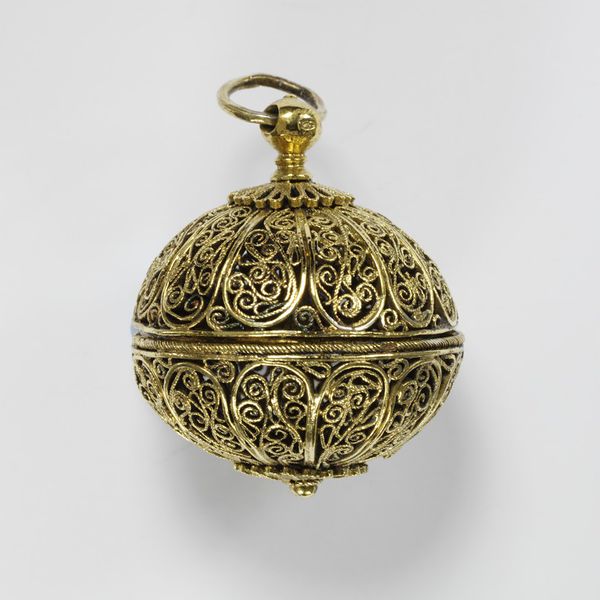
Pomanders (from the French pomme d’ambre) were items of jewellery that contained fragrant aromatic substances such as ambergris, musk, clove or civet, and commonly hung from the neck or the waist. Popular since medieval times they were believed to ward off infection during times of plague (as it was thought that disease was transmitted through foul air). However, by the eighteenth century they were used mostly to cover up bad smells, particularly in cities such as London were the streets were often filled with household waste and excrement. They also took part in the social etiquette practices of the day.

Pomander. 1600-50. European. Victoria & Albert Museum, London

 Purses

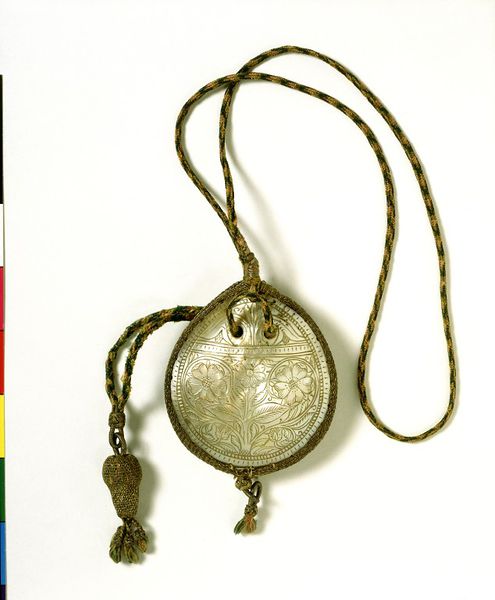
This woman wears a gown, falling lace band and also holds onto a fan. More interestingly though she appears to have a purse dangling from her waist. In the seventeenth century purses such as this were rarely used to actually carry money, as women such as the one depicted in this engraving rarely engaged in commercial exchanges that required cash. These purses could also contain mirrors (which is probably indicates what it was most commonly used for). They could also be used to carry around sewing materials or sweets, and other bits and pieces.

Purse, 1600-1630. England.  Victoria & Albert Museum, London

Muffs

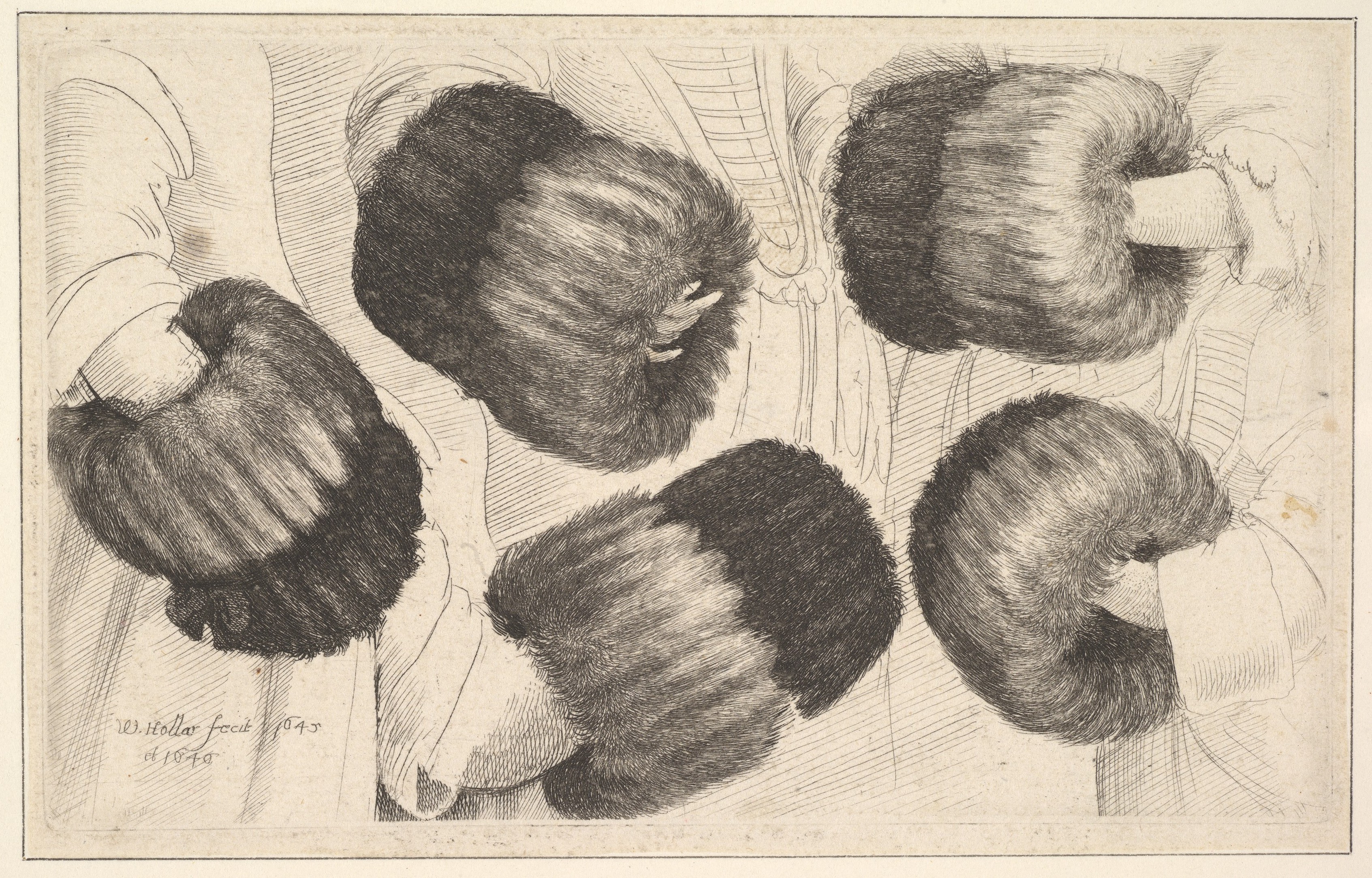
Muffs in the seventeenth century, as they are now, were design to keep the wearer’s hands warm when outside. They are believed to have first come about in the sixteenth century, possibly originating from the fur trim that was common on the cuffs of a gown. Most muffs during this period appear to have been made from fur, although there are fabric muffs such as this one from the eighteenth century, so it is totally plausible that they were also made from fabric too. In my archival research on English royal wardrobes I’ve actually never come across a muff, well, in tailoring bills anyway. So I’m not sure exactly where they were sourced. Nor have I been able to find any extant seventeenth-century examples in museum collections. The best we have from the period is other drawings from artists like Hollar, such as:

In fact that there are SO many engravings of muffs by Hollar. It would seem that really really liked women’s muffs (double entendre intended)!

Masks


The woman on the left wears an over cape, a muff and has a purse dangling from her waist. Whilst the woman on the left wears a fashionable gown with a falling lace collar and holds a muff. What both women have in common is that they are wearing masks.

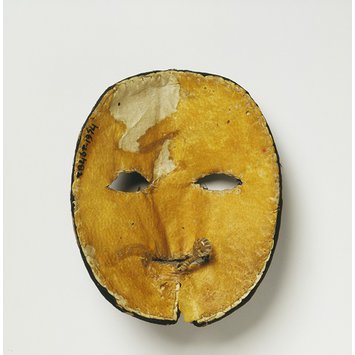
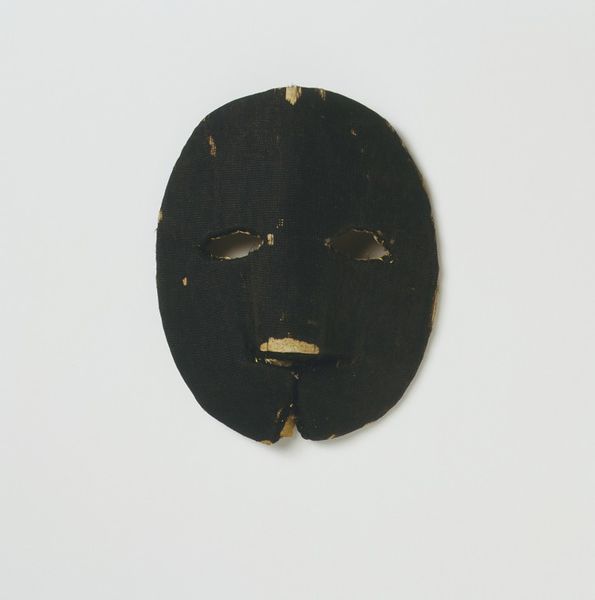
Masks were, believe it or not, worn frequently in the streets of England during the late sixteenth and seventeenth centuries. Full faced masks were used primarily to shade the wearer’s face from the sun’s rays, as the wearers were usually aristocratic women whose pale skin reflected their position in life. They were held in place on the face by holding a glass bead that was attached to the mask between the teeth, which would have made it quite difficult to talk! Some of these masks have survived and were made from black velvet and silk/leather, such as this one found in the wall of a sixteenth-century building in England. Or the one below which comes from a fashion doll and dates to the 1690s.


Dolls Mask, 1690-1700. Victoria & Albert Museum, London

The masks in these picture though are not fulled faced, and so were probably not used for sun protection. Instead they could have been used by women to disguise themselves. Samuel Pepys, in a diary entry from 18th February 1667, describes such a woman at a playhouse he attended:

“And one of the ladies would, and did sit with her mask on, all the play, and, being exceeding witty as ever I heard woman, did talk most pleasantly with him; but was, I believe, a virtuous woman, and of quality. He would fain know who she was, but she would not tell; yet did give him many pleasant hints of her knowledge of him, by that means setting his brains at work to find, out who she was, and did give him leave to use all means to find out who she was, but pulling off her mask. He was mighty witty, and she also making sport with him very inoffensively, that a more pleasant ‘rencontre’ I never heard.”

Hats

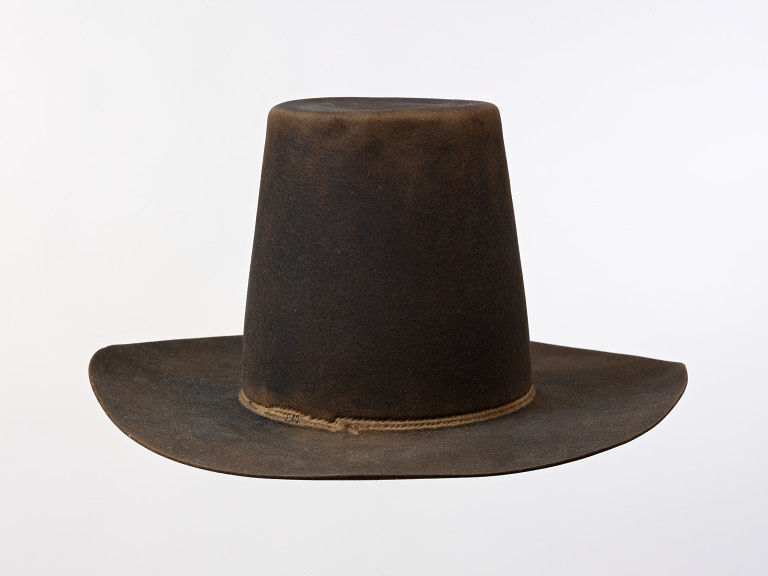
Hats like this were worn by both men and women during the seventeenth century. Hats could be made from felted beaver or rabbit fur, such as the one from the Victoria and Albert Museum below, or from leather such as this example also from the V&A. They could also have really tall, narrow “steeple” crowns such as this one which were favoured by the Puritans who wished to distinguish themselves from the ostentatious cavaliers. Over the course of the seventeenth century vast amounts of beaver fur used in hat making in Britain was imported from their colonies in North America, making them more affordable as the previous European Beaver was scarce as it had been nearly hunted to extinction. According to the V&A the felting process involved the fur being removed from the animal pelt and then heated to fuse it together. It was then moulded into shape around a wooden form, dyed, trimmed and smoothed.

Felted Hat, 1590-1670. England. Victoria & Albert Museum, London

The woman in this picture is most likely a middling class city woman. Felt hats were common among all classes of people in the seventeenth century. They were used as riding headwear for elite women and as everyday wear for the gentry and middling classes. Hats were also particularly common in rural areas of Britain, understandably as rural people usually spent more time outdoors in fields. However, as felt hats were still expensive they would probably have had similar styles made from leather.

The 1629 probate inventory of Arthur Coke, listed in part of his late wife’s clothing “j [1] black beaver hatt with a bond of gold smythes – worke of starrs and half moones & iij [3] other bands of silver & gold”, indicating that the bands on these hats could be incredibly decorative as well. Hats could also be pointed, looking like what we now think of at witches hats, such as the one worn in the painting Mrs Salesbury with her Grandchildren from 1675-6.

Portrait of Mrs Salesbury with her Grandchildren Edward and Elizabeth Bagot 1675-6 by John Michael Wright 1617-1694

Portrait of Mrs Salesbury with her Grandchildren Edward and Elizabeth Bagot, by John Michael Wright. 1675-6. Tate Gallery, London

Ruffs & Collars

It is interesting that this particular lady is wearing a ruff as by the 1640s falling collars were more the norm. I’ve certainly found no evidence of ruffs in all the probate inventories and household bills that I’ve looked at from the 1630s/40s. Maybe this is an anomaly?

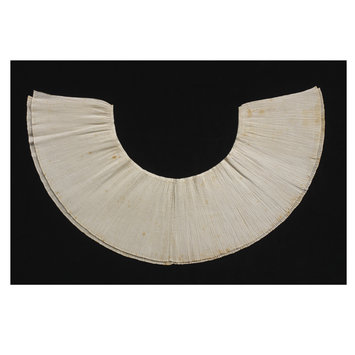
A more common “ruff” from this period. Ruff, 1620-29. England. Victorian and Albert Museum, London

Ruffs were particularly expensive to produce and to maintain: firstly they required a lot of fabric, they constantly had to be re-starched and bleached, and setting them back into shape was also time consuming and costly in terms of labour. Yet looking closely at this picture and comparing it to the ones above, from her dress this woman doesn’t appear to be particularly elite. Possibly she is middling class which could explain why she is still wearing a ruff – fashionable tastes changed a lot more in the courts and among the wealthy than they did in the lower classes and if she was the wife of a merchant for example she could afford the upkeep of the ruff. Very intriguing indeed…

Waistcoats

This woman wears a coif, a falling collar, waistcoat and petticoat. She appears to also be wearing an apron, which indicates that she was most likely a middling or common class woman. In her right hand she also holds a pair of gloves. Interestingly if you enlarge the picture and look really closely at the embroidered detail on the waistcoat it looks just like this one in the V&A which is made from fustian and embroidered with silver thread and spangles:

Waistcoat, English, 1630-40. Victoria & Albert Museum, London

During the early seventeenth century a waistcoat was one of the most basic items in a woman’s wardrobe. Both elite and common women owned waistcoats. A tailoring bill for the wardrobe of Queen Henrietta Maria from 1634 noted that she had ordered “one Petticoate & wastcoate of black Taby with twoe Silke & Silver Laces throughout.” The probate inventory of Agnes Hilling, a Widow from Clifton England in 1634 records that when she died she possessed “wearing apparell” that consisted of “three gownes, three pettiocoatts, 3 Wascoats, one Aperne, a bond and diveres other things of her Wearinge apparell…”

 Pattens

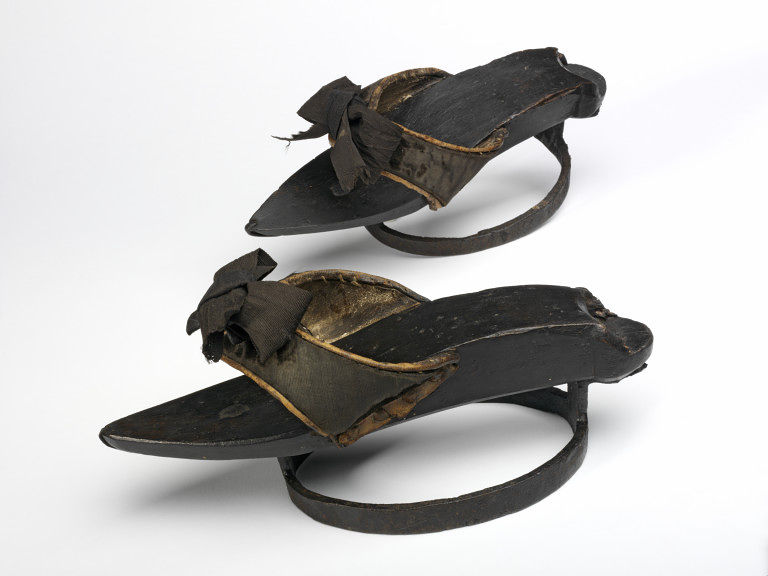
On the University of Toronto’s website this picture is listed as “The Kitchen Maid”. She wears a coif, waistcoat, and a couple of petticoats. She is carrying what I assume is vegetables and other foods for the kitchen that she works in. The most interesting detail of this engraving is her shoes, or really what I should say is attached to them. These under-shoes were called ‘pattens’ and were designed to lift the wearer out of the mud and waste of early modern streets. They were usually made from wood or metal and slipped over the shoes on the wearer’s foot. Although primarily worn by common or country women, this pair from the early eighteenth century have pointed toes to fit a fashionable woman’s shoe and a spot at the back for the heel to sit. The latchets are also covered in velvet which suggest that they would have been worn by a woman with wealth.

Pair of pattens, Great Britain, 1720s-30s. Victoria & Albert Museum, London

For all their benefits in keeping shoes out of the city street muck, it seems that pattens must have been terribly difficult to walk in. The Burlesque “Scarronnides, or, Virgile travestie a mock poem” a modern retelling of the fourth book of Virgils Aeneid by Charles Cotton published in 1665 proclaimed that,  “But to the Church (forsooth) anon/ …They must, and slipping on their Pattens / They went, as who should say to Mattens.” On 24 January 1660 Samuel Pepys similarly wrote in his diary that, “I called on my wife and took her to Mrs Pierce’s, she in the way being exceedingly troubled with a pair of new pattens, and I vexed to go so slow.”