17th century, Manuscript / Archival Research, Research, Seventeenth-century fashion, Stuart

Did Seventeenth-Century English Women Wear Drawers?

A question I see pop up often, and one that continues to spark much debate in online costuming communities and between historians of dress is: Did early modern women wear anything under their skirts? If so, did they wear drawers?

Susan North’s recently published book, Sweet and Clean?, is one recent scholarly text that has tackled this question. In the book she offers ample evidence for the use of drawers by men during the seventeenth and eighteenth centuries.[1] When it comes to women, she writes that ‘drawers for women, [is] a question that continues to baffle dress historians’.[2] She offers examples of women wearing drawers in the eighteenth century to argue that it was indeed possible for women to wear such an undergarment. However, she does not provide evidence for the seventeenth century.

Most surviving evidence of drawers being worn by women comes from sixteenth-century Italy, where sources described sex workers as wearing these garments in gender-bending displays of eroticism and the subversion of social norms.

Ferrando Bertelli (Publisher), Venetian Woman (likely a courtesan) with Moveable Skirt, 1563, Italian. Metropolitan Museum of Art, New York

Early modern English ballads depict men and women fighting over what could be drawers or breeches, or, more literally, fighting over who wore the pants in the relationship. The wearing of drawers by women in the context of this type of moralising literature made their husband into a cuckhold, thus undermining his authority and threatening early modern ideas of masculinity.

The Jolly Widdower: / OR, / A Warning for BATCHELORS (Printed for I. Blare, at the Looking glass, on London Bridge, c. 1664-1703). The English Broadside Ballad Archive.

However, moralising literature often tells us more about anxieties early moderns held, rather than the reality of what was actually happening, especially when it comes to dress practices. In this blogpost then I want to set the record straight that, yes, women could and did wear drawers in the seventeenth century.

The earliest example from the seventeenth century is a pair of drawers on the effigy of Queen Elizabeth I in Westminster Abbey. Funerary records show that these were specially constructed in 1603, as a warrant relating to funeral expenses noted,

‘And to John Colte for the Image representing her late Majestie with a paire of straight bodies a paire of drawers…’[3]

Janet Arnold examined these drawers and noted they were likely made of fustian and gathered into a waistband that had worked eyelet holes similar to those on breeches. Whether this is a garment that Elizabeth wore (Arnold does not mention if they appear in her accounts) or if they were made to pad out the hips and legs of the effigy (they are stuffed with what appears to be hemp) is unknown.[4]

Drawers on the effigy of Elizabeth I, 1603. Westminster Abbey, London.

By the 1630s, Queen Henrietta Maria’s accounts contain multiple references to drawers made from linen and wool.

In May 1631 her French tailor George Gelin billed the wardrobe for:

‘18 pare of Holland drawers for her majesty binded with ribbon for the making of them’.[5]

On 17th August 1639, Henrietta Maria’s other tailor James Bardon

‘delivered into the office of her Majesty’s wardrobe two pair of woolen drawers for the mend & bordering of them’.[6]
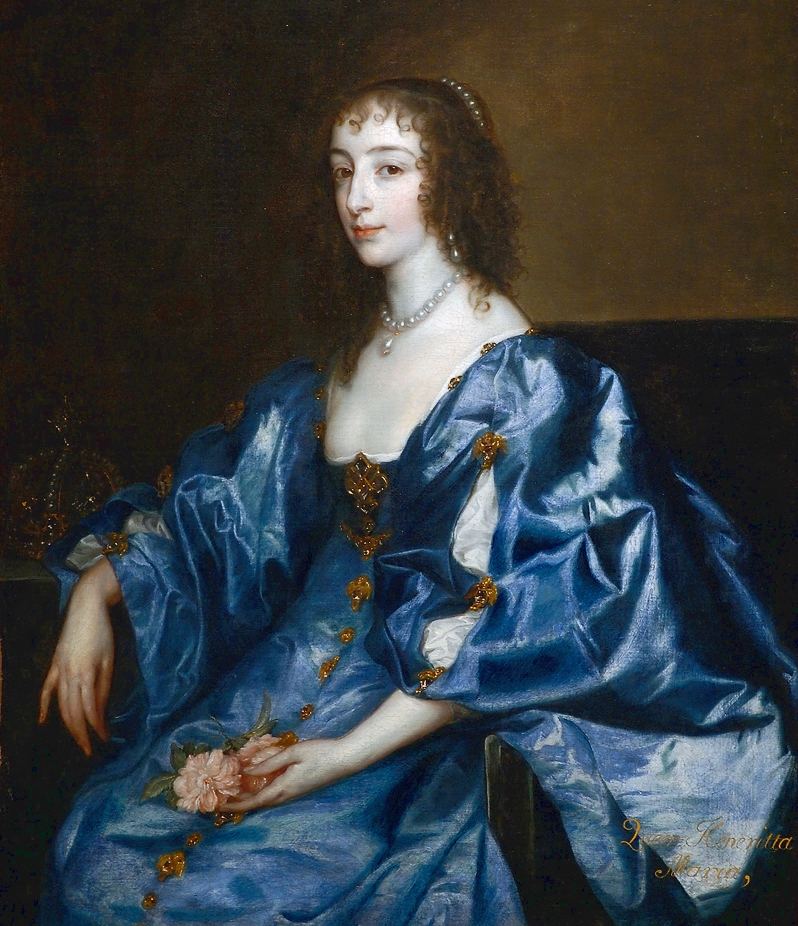
Anthony van Dyck, Portrait of Henrietta Maria de Bourbon, Queen of England, c. 1636-8. San Diego Museum of Art.

While it is possible that the queen’s drawers were the result of French influence on her wardrobe (she was after all a French princess), there is also evidence that non-royalty wore these undergarments around the same time too.

In 1642, the probate inventory of the widow Elizabeth Burges of St. Nicholas Parish in Bristol recorded

‘one payer of cotten drawers at                 s. j [1 shilling]’[7]

Here cotton likely referred to a woollen fabric rather than cotton-fibre textiles. Whether these drawers belonged to Elizabeth, or another family member such as her husband is unclear.

In the 1660s Samuel Pepys made ambiguous references to the morality of his wife Elisabeth’s drawers as he was frequently concerned about whether she wore them when visiting her male dance teacher (who Pepys often suspected she was having an affair with).[8]

He recorded in his diary on the 15 May 1663 that

‘But it is a deadly folly and plague that I bring upon myself to be so jealous and by giving myself such an occasion more than my wife desired of giving her another month’s dancing. Which however shall be ended as soon as I can possibly. But I am ashamed to think what a course I did take by lying to see whether my wife did wear drawers to-day as she used to do, — and other things to raise my suspicion of her, but I found no true cause of doing it’.
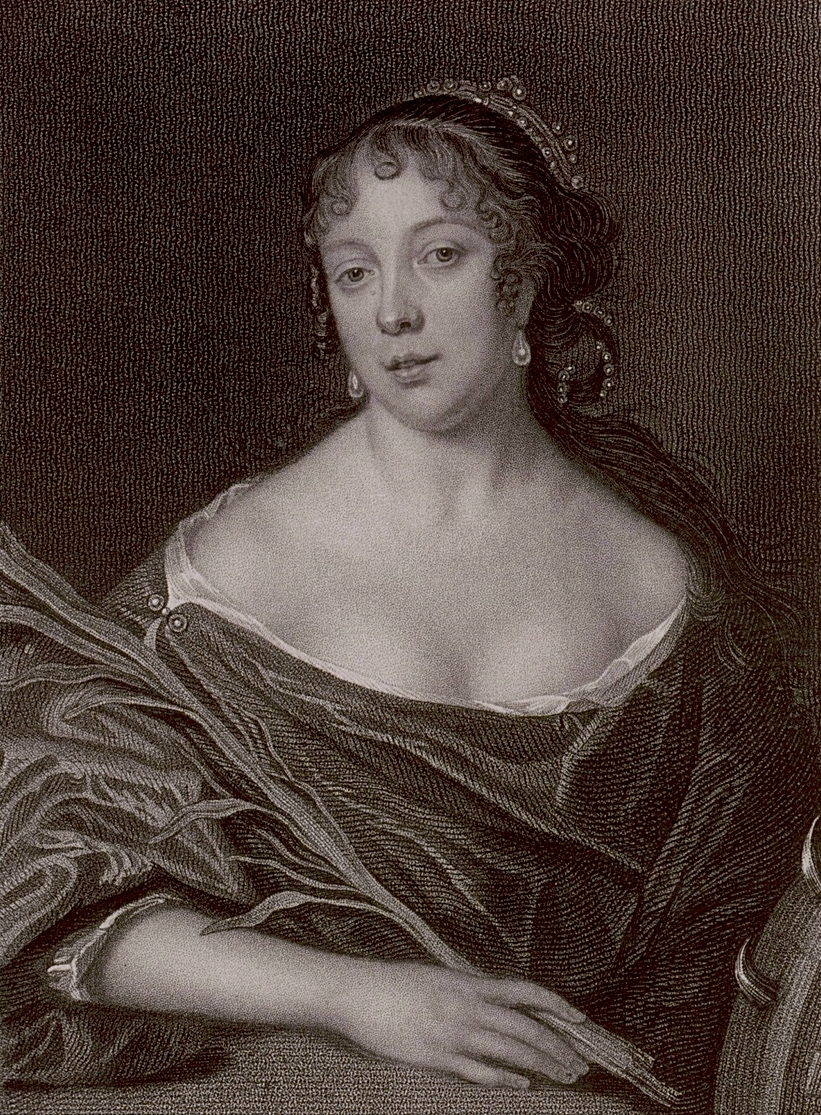
James Thomson (engraver), after John Hayls, Elisaebth Pepys, c. 1825 (copy of original seventeenth-century portrait, now destroyed).

On 4 June of that same year, Pepys again wrote that

‘I whiled away the morning up and down while they got themselves ready, and I did so watch to see my wife put on drawers, which poor soul she did, and yet I could not get off my suspicions, she having a mind to go into Fenchurch Street before she went out for good and all with me, which I must needs construe to be to meet Pembleton, when she afterwards told me it was to buy a fan that she had not a mind that I should know of, and I believe it is so’.

Rather than wearing drawers indicating a lack of morals or a proclivity to promiscuity (as it did with Italian courtesans) it appears that Pepys was more concerned with whether his wife might allow her dance teacher easy access to her nether regions by not wearing this garment.

In 1688, the linen draper supplied Queen Catherine of Braganza’s wardrobe with

‘fine frieze holland for drawers for her majesty’.[9]

Although a bill does not survive, presumably it was Catherine’s seamstresses who made these linen drawers up, along with other goods from the linen supplied.

Peter Lely, Portrait of Queen Catherine of Braganza, c. 1663-5. Royal Collection.

Both men and women could wear drawers during the seventeenth century, and tailors and seamstresses made these garments for both genders. It appears that, like North has suggested for the eighteenth century, women likely wore them for warmth or riding. Or as Pepys’ diary entries suggest, even modesty. Or perhaps the comment by Pepys about his wife being a ‘pour soul’ for putting on drawers was because it was summer and the weight of all her skirts would already have been hot. Timing of the queens’ bills suggests that woolen drawers were more common in winter and linen in summer, although a much larger sample would need to be taken to determine this.

Much more research is needed the make firm statements about the history of women’s drawers in the early modern period. As Pat Poppy helpfully points out in her comment below, most of these references relate to Francophile women living in England: Henrietta Maria was a French princess and Elisabeth Pepys’ father was French (her mother was not). Catherine of Braganza’s wardrobe, as my forthcoming book will show, was also heavily influenced by French fashions. So was this a French thing?

I will continue to update this post as I come across references. But what is certain is that drawers were certainly owned and worn by some women in seventeenth century England. How widespread the practice was remains to be determined.

References


[1] Susan North, Sweet and Clean?: Bodies and Clothes in Early Modern England (Oxford: Oxford University Press, 2020), 126-30.

[2] North, Sweet and Clean?, 131-2.

[3] The National Archives UK (TNA), E 351/3145, fol. 25, transcribed and cited in Janet Arnold, ‘The “pair of straight bodies” and “a pair of drawers” dating from 1603 which Clothe the Effigy of Queen Elizabeth I in Westminster Abbey’, Costume, 41 (2007), 9.

[4] Arnold, ‘The “pair of straight bodies”’, 8-9.

[5] TNA: LR 5/64.

[6] TNA: LR 5/67.

[7] Transcribed in Edwin George, Stella George and Peter Fleming, eds., Bristol Probate Inventories, Part 1: 1542-1650 (Bristol Record Society, 2002), 125.

[8] https://www.pepysdiary.com/diary/1663/05/15/#c47569 and https://www.pepysdiary.com/diary/1663/06/04/

[9] TNA: LR 5/83.

17th century, 18th century, Manuscript / Archival Research, Research, Stuart

Quilted Petticoats in the Seventeenth Century

Quilted petticoats in England and America are usually attributed to and discussed in the context of the eighteenth century. This is likely due to the fact that all the earliest surviving quilted petticoats (to my knowledge) date from this period.

Quilted Petticoat, c. 1740-60 (made), 1870-1910 (altered), British. Victoria and Albert Museum, T.430-1967.

I am currently writing a book about the women who made, sold, managed and cared for the clothing of England’s Stuart queens during the period 1603-1714. As I have been transcribing their wardrobe accounts I have come across several references to quilted petticoats.

But firstly, what is a petticoat? The term ‘petticoat’ began to appear in English in the sixteenth century when it was used interchangeably with the preexisting term ‘kirtle’. At this time, and until the mid-seventeenth century, petticoat usually referred to a skirt that had an attached, sleeveless bodice (known as “petticoat bodies”). A petticoat with an attached front lacing bodice is visible in the painting below.

The woman who is standing on the right in this scene is lacing up her petticoat (skirt and attached bodice), which she wears underneath what appears to be a waistcoat (jacket) and jerkin. Frans Francken the Younger, The Witches’ Kitchen, 1606, Hermitage Museum.

By the second half of the seventeenth century, “petticoat” generally began to refer only to the skirt. Petticoats could be under or outer wear. Women often wore many layers of petticoats at this time made from various different materials. This brings me to quilted petticoats in the seventeenth century.

Evidence from the Queens’ Accounts

Did quilted petticoats exist in the seventeenth century?

Yes! They did.

Quilted petticoats begin to appear in the royal accounts after the reign of Henrietta Maria. Unfortunately, the first twenty years of accounts belonging to Catherine of Braganza have not survived. However, those during the 1680s do.

In the Christmas quarter of 1685-6, several “Quilted coats[s]” were made or altered for dowager Queen Catherine of Braganza. At thsi time, the queen’s tailor and dressmakers also provided “new Eaching & Ribanding” for “a Quilted coat” and widened the “Wasts of 3 Quilted Coats.”[1] 

During the early 1700s, Queen Anne was provided with several types of quilted petticoats.[2] These included garments described as “white Quilted under peticoats.” The fabrics that these quilted under petticoats were made from are not mentioned, but if can be assumed that they were some sort of linen, as silks were usually specified in these accounts.

In later periods, quilted petticoats were primarily worn for warmth and this was no different in the late seventeenth century. Even when quilting wasn’t mentioned, wadding of silk, “ferret” and of an unspecified nature (likely wool or cotton) were also frequently listed in Queen Anne’s accounts. For example:

“a scarlet velvet under peticoat _ _ _ _ _ _ _ _ 1-5-0
silk wadding and shaloon _ _ _ _ _ _ _ _ 0-10-6″

Other Evidence

It is likely that the quilted petticoats belonging to Catherine of Braganza and Queen Anne resembled the quilted petticoat belonging to a doll known as Lady Clapham (fig ). The doll portrays fashionable clothing worn by wealthy women during the 1690s and is believed to have belonged to the Cockerell family who had a family home in Clapham, London. This petticoat shows the same sorts of decorative needlework that we see on later eighteenth century examples.

But quilted petticoats were not just common among queens and other elites in England.

In 1688, Thomas Barlow and Oliver Morris of St. Giles’s in the Fields were Indicted for entring the Dwelling-house of John Appleby” and stealing “one Silk Flowred Gown, value 40 s. one Quilted Petticoat, value 10 s. one Crape Petticoat, value 8 s. a pair of Sattin Stayes, value 10 s. and other goods of Ann Thomas.”[3] All these items appear to have been part of an ensemble, the gown was likely a new fashionable mantua gown.

Later, in 1692, Elizabeth Morgan (alias Jones) and Sarah Chandlor were tried for stealing a quilted petticoat from Faith Butler in London too.[4] By 1697, quilted petticoats were also referenced in The provok’d wife a comedy by John Vanbrugh.

These garments therefore appear to have been a relatively common sight by the end of the seventeenth century in places such as London.


References

[1] TNA: LR 5/81

[2] BL: Add MS 61407

[3] https://www.oldbaileyonline.org/browse.jsp?id=t16880113-41&div=t16880113-41&terms=quilted_petticoat#highlight

[4] https://www.oldbaileyonline.org/browse.jsp?id=t16921207-40&div=t16921207-40&terms=quilted_petticoat#highlight

16th century, Manuscript / Archival Research

Isabella d’Este’s Chemises – Translations from the 1539 Inventory

RP-P-OB-33.124
Seventeenth-century copy of Titian’s painting of Isabella. From the Rijkmuseum, Amsterdam.

I was recently asked to be an allied researcher on the ACIS project Textiles, Trade and Meaning in Italy: 1400-2018, particularly in relation to the clothing and textiles at the court of Mantua under Isabella d’Este. As part of this project I was asked to write a short piece on Isabella’s underwear, as part of a collection of short essays that will accompany the portrait of the Marchesa by Titian on the Isabella D’Este Archive (IDEAS).

Now Isabella was living at the time in the early sixteenth century when the undergarments that my work usually focuses on – bodies and farthingales – were not yet found in the wardrobes of Italy’s elites (although bodices as an outer-garment were certainly available). So that left me to write about Isabella’s main undergarments – her chemises or smocks.

To write about this topic firstly I needed to get an idea of what sort of chemises Isabella actually owned. This is where this great edited volume came into play:

Daniela Ferrari, Le Collezioni Gonzaga: L’inventario dei beni del 1540–1542, ed. Daniela Ferrari (Milan: Silvana, 2003)

The volume contains many inventories relating to the Gonzaga family of Mantua, including Isabella’s household and wardrobe inventories that were taken after her death.

My contribution to the project is not up on the website yet, but in the meantime I wanted to share my English translations of some of the chemises in Isabella’s post-mortem inventory from 1539. Please note that these are my english translations of some of the text from the Gonzaga volume, so all credit goes to Daniela Ferrari for transcribing and publishing these records from the original papers. 

The Translations

  • Camise (from Stivini, Le Collezioni Gonzaga, 234)

Una camisa da bagno de banbaso, lavorada de oro
A bathing chemise of linen, wrought with gold

una camisa de cambraglia granda, lavorada de oro
A large cambric chemise, wrought with gold

una camis da homo de cambraglia, lavorada de oro
one men’s cambric shirt, wrought with gold

due camise de bambaso, lavorate di seda negra suso le crespe
two linen chemises, with black silk trimmings under the pleats/folds

una camisa di tela batiza lavorada di seda negra, inzipado il colar
one chemise of fine linen cloth with black silk work, around the collar
[tela batiza = cloth used for baptisms, so a fine linen cloth]

una manica de camisa de cambralia, lavorata de oro seda de più colori,
one sleeve of a cambric chemise, wrought with gold silk of more colours

quatro grombiali di cambralia, lavorati cum oro, listadi al longo, videlicet uno di seda negra,
four cambric smocks, wrought with gold thread, striped vertically, one of which is black silk

uno par de maniche large, listade cum lavorerii di seda negra
one pair of large sleeves, with stripes of black silk

Of interest here is Isabella’s bathing chemise. These chemises may have resembled those worn by the bathmaids in the image from this fifteenth-century bible from the Library of the National Museum in Prague. Perhaps the gold work in these chemises refers to the neckline and straps that are visible on these garments. Isabella may have worn this chemise or one like it when she visited the hot springs at the thermal spa of Abano south of Padua in 1532 (Shaw, 275).

bathing chemise Praha, Knihovna Národního muzea, IV.B.24

  • Camise (from Stivini, Le Collezioni Gonzaga, 240)

Due camise di tela de renso, lavorate di seda zizola, videlicet una a traverso e una al sbiasso,
Two chemises of Rheims linen, worked of silk dyed with the fruit of the jujube, one embroidered crosswise and the other biaxially

due camise di tela di renso, lavorate di seda cremesina, videlicet una al longo e l’altra al traverso
two chemises of cloth of fine linen, wrought of with silk dyed with kermes, one with the embroidery lengthways and the other horizontally (sideways).

due camise di tela di renso, lavorate cum seda turchina, listadi al longo
two chemises of cloth of fine linen, wrought with turquoise blue silk and striped vertically

una camisa di tela di renso, lavorata cum seda incarnada
one chemises of cloth of fine linen, wrought with bright red silk

una camisa di tela di renso, lavorata cum seda morella,
one chemise of cloth of fine linen, wrought with mulberry red silk

due camise di tela di renso, lavorate cum seda turchina, videlicet le cositure maestre,
two chemises of cloth of fine linen, wrought with turquoise blue coloured silk on the front.

quarantaotto camise di tela di renso, da notte, lavorate cum seda negra,
Forty-eight nighgowns of Rheims linen, wrought with black silk

decesette camise di tela di renso, all spagnola, lavorate cum seda negra
seventeen chemises of Rheims linen, Spanish style, wrought with black silk

due camise di tela di renso, all spagnola, lavorate cum seda biancha
two chemises of cloth of fine linen, Spanish style, wrought with white silk

The chemises embroidered with silk threads of various colours around the collars and cuffs may have resembled a contemporary men’s shirt in the Victoria and Albert Museum in London.

2009BW6757_jpg_l
Shirt, English, c 1540. Linen, linen thread, silk thread. London: Victoria and Albert Museum, T.112-1972.

Sources:

Daniela Ferrari, Le Collezioni Gonzaga: L’inventario dei beni del 1540–1542, ed. Daniela Ferrari (Milan: Silvana, 2003)

Christine Shaw, Isabella d’Este: a Renaissance Princess (Abingdon, Oxon: Routledge, 2019)

http://realmofvenus.renaissanceitaly.net/library/fabricglossary.htm

*** Many thanks to Professor Carolyn James and Jessica O’Leary for their assistance with these translations. 

16th century, 17th century, Bodies and Stays, Jacobean, Manuscript / Archival Research, Object Research

Bodies or Stays? Underwear or Outerwear? Seventeenth-century Foundation Garments explained.

2003-109-2e
Bodies and Stomacher of Dame Elizabeth Filmer (front), c. 1630-1650. Gallery of Costume, Platt Hall, Manchester Art Gallery, Manchester

What should we call the torso-shaping female foundation garments of the seventeenth century? Were they pairs of bodies? Bodices? Stays? Corsets? Moreover, how were they worn? Were they underwear or were the outerwear?

This post was inspired by a question that I saw written on an Instagram post uploaded by the very talented Morgan Donner about a pattern from the new Patterns of Fashion 5:

“17th Century things are so 😍… one thing I’m curious about is that I’ve seen boned bodices for gowns, and then stays, and then stays with sleeves. I assume the latter are basically worn as “tops”, and that boned gown bodices obviously wouldn’t have stays under them… so are the stays only for under the lovely embroidered jackets and such?”

As I did my PhD on bodies and farthingales, and my forthcoming book Shaping Femininity examines these garments and the lives of the women who wore them, this question inspired me to make this post to clear the air. Not just about terminology, but also in an attempt to answer this question as it is much more complicated than it seems!


Bodies or Stays?

As long-term followers of my blog and my research my have surmised, I rarely use the term “stays” when I talk about sixteenth and seventeenth-century foundation garments, even though museums and other publications almost always do. Randle Holme’s famous 1688 manual most famously makes the distinction between “smooth covered stays” and “stitched stays”, something which Jenny Tiramani emphasises in the new Patterns of Fashion 5: The content, cut, construction and context of bodies, stays, hoops and rumps c.1595-1795.

Why then do I not use the term stays when so many others do? Well, in my almost six years of archival research  I have never seen the term “stays” used in historical documents to refer to these garments until at least the 1680s, which is when Randle Holme was writing.

The term stays does appear in the records from the middle of the century, however, it always refers to the stiffening in the garments that are being made – not to the garments themselves. Artisan’s bills will often quote a total price for the garment and then break down the price of each component of that garment. For example, a tailor’s bill might look something like this:

A pair of bodies of crimson satin bodies with silver lace ______ 00 – 00 – 00
for 1 yard 1/2 of silk at 11s the yard ________ 00 – 00 – 00
for calico to the lining __________ 00 – 00 – 00
for silver lace to them __________ 00 – 00 – 00
for stayes and stiffenings __________ 00 – 00 – 00
for making and furnishing ___________ 00-00-00

Therefore, “stayes and stiffenings” refers to the materials used to stiffen these garments like whalebone, not to the actual garment itself. Additionally, “stays” referring to stiffening does not just appear in women’s clothing bills. I have also found references to “stay and buckram” in tailoring bills for menswear, such as a suit and coat from 1680 on this occasion.

This is why in my own research I use the terminology “bodies” or “pair of bodies” when I refer to these garments that would later come to be called stays and corsets. For me it is important to use the terminology that was used at the time, otherwise we are placing slightly anachronistic modern assumptions onto this clothing. This becomes especially important when it comes to answering the next question of this blog entry regarding the ambiguity of bodies as under or outer wear in the seventeenth century.


Underwear or Outerwear?

giphy

As you can probably tell the early modern term “bodies” sounds an awful lot like the modern term “bodice”, and that is because the term bodice is derived from bodies! Anybody who has read early modern English sources before knows that there was little to no standardised spelling at the time, and so words were regularly spelled different ways (even when they were only sentences apart). Thus, these are terms that are regularly conflated and used interchangeably in the archival sources from this century.

Variations in spelling included: bodies, bodyes, bodis, bodice, boddisses, etc. “I” and “Y” were interchangeable vowels in the sixteenth and seventeenth centuries so “bodys” could be spelt “bodis” and then “bodis” spelt “bodice” (so bodys = bodis = bodice, confused yet?). So there appears to be no rhyme or reason for most of the century as to what a “bodie” is vs a “bodice”, or whether one is an under garment or an outer garment.

In the seventeenth century there was no firm distinction between under and outer wear as we see in later centuries when it came to bodies, or other items of women’s dress like petticoats. So “bodies” could be either outerwear or underwear, it all depended on a woman’s social status, the occasion she was dressing for, or maybe her own personal taste. Some surviving bodies from this century contain detachable sleeves (that are laced on with points), indicating that the uses of this garment were flexible, and its use could be easily manipulated depending on the situation it was worn in. Detachable sleeves were also worn in earlier Elizabethan petticoats (see more about that here).

2010EB2907_2500
Bodies with detachable sleeves, pink watered silk trimmed with pink silk taffeta ribbons, English, c. 1660-1670. Victorian and Albert Museum, London

Detachable sleeves on elaborate bodies may have been worn with a matching skirt to form a gown, but on other occasions the sleeves may have been taken off and the bodies worn underneath what we would now call a jacket (but at the time was known as a waistcoat).

1660s_gown_bodies_detachablesleeves_bendall
1660s Gown containing a pair of bodies with detachable sleeves. Reconstruction by Sarah A Bendall

The particular decade of the seventeenth century being investigated is also important. For example, the 1660s saw the rise of the very rigid bodices that were retained for court wear in countries like France well into the eighteenth centuries. The highly boned nature of this garment meant that separately boned bodies were not needed or worn underneath. However, I would be hesitant to claim that this means that under-bodies were discarded during these centuries – as this highly boned style was not universally worn, nor would it have been worn all the time, even by elite women.

ivory satin bodice vna
Ivory Satin Bodice, English, c. 1660-1669. Victorian and Albert Museum, London

Overall, there doesn’t seem to have been any hard or fast rules for how to wear bodies during the seventeenth century, and there definitely was not the major distinction between underwear and outerwear like there is in regards to stays later in the eighteenth century, or the corsets of the nineteenth century. However, there is still a lot to uncover, and I hope to tackle this question in my forthcoming book, so who knows, maybe soon I will have a better answer!


16th century, 17th century, Elizabethan, Jacobean, Stuart

Back to Basics: The Smock in the Sixteenth and Seventeenth Centuries

As many of you know, during my PhD I decided to reconstruct four items of female structural dress from the sixteenth and seventeenth centuries. However, in order for the reconstructions to be worn during photoshoots the most basic female undergarment of the the early modern period was needed: the smock.

The Smock – A Brief History

Smocks or shifts (‘chemise’ in French) were the most basic undergarment of all women and men (men’s were referred to usually as shirts) in sixteenth-century Europe. Indeed they had been the base layer of dress for hundreds of years and would remain so, in one form or another, until the twentieth century. During the early modern period they were made from linen, sometimes silk, and later cotton, and sat closest to the historical body. Smocks and shirts were worn underneath every type of clothing, and as a result even the poorest person owned a few smocks, and rich elites often owned dozens. For a description of the chemises owned by Isabella d’Este and recorded in the inventory made upon her death in 1539 click here. 

Throughout the seventeenth century various styles of smocks and shifts developed – from those that were intricately embroidered such as the one below, to those that had elaborate frills around the cuffs and neckline. Interestingly, it was these frills that would eventually turn into a separate accessory in the second half of the sixteenth century – the ruff.

2009BW6757_jpg_l
Examples of early embroidered frill on cuffs and neckline.  Man’s Shirt, c. 1540, England. T.112-1972. Victoria and Albert Museum, London

Smocks and shirts served two main purposes during the sixteenth century. During the early modern period outer garments, especially those made from luxurious fabrics such as silks and velvets, were rarely laundered in order to maintain the condition of the fabric. It was the smock then that absorbed sweat and other body excretions, and it was this item that was regularly cleaned and laundered instead.

Medical theory during this period also viewed the skin as porous and weak and the hot water from public baths or full immersion bathing was believed to create openings for disease such as plague to slip through.  Linen, as a porous fabric, therefore replaced the role of skin in bathing practices, as it was believed to absorb dangerous matter that could then be laundered and removed away from the body.   Thus, instead of cleaning the skin one would simply remove and clean their ‘second skin’ – their smock.[1]

2006AM8281_jpg_l
Woman’s Smock, c. 1615-1630, England. T.2-1956. Victoria and Albert Museum, London

Cleanliness by the seventeenth century therefore was not focused on the body of skin and flesh, but measured by the cleanliness of linen and the display of objects and garments in external appearance.[2] Kathleen M. Brown has noted that “a clean linen shirt, complete with ruffs and lace at the neck and wrists, indicated not only the wearer’s refinement, attention to fashion, and wealth, but his access to the services of a laundress”, and his attention to cleanliness.[3] Therefore the whiteness of smocks and shifts, rather than the body itself, was linked to cleanliness during this period.[4]

This idea is probably best exhibited through the following instance: at one point yellow linens became so popular in London during the early seventeenth century that critics were quick to associate them with the uncleanliness of the Spanish courtiers who used saffron dye as a way to deter vermin, and with the neglected hygiene of those Europeans in hot climates whose sweat and lack of access to laundering turned the colour of their white shifts to yellow.[5]

All smocks during the sixteenth and early seventeenth century (and beyond) were similar in construction, they were made from a collection of basic geometric shapes: rectangles, squares and triangles. These pieces were cut from standards lengths of linen. Although regional differences could exist. Smocks and shirts were usually sewn in the home by women, or female seamstresses were employed.

eMuseumPlus
A Seamstress sewing a Linen Garment . The Virtuous Woman, Nicolas Maes, c. 1655. Wallace Collection, London

Smocks also changed in style throughout the early modern period in England depending on the styles of outer clothing worn. Necklines could be high such as on the smock above, or fashionable bodices and gowns that had necklines cut horizontally off the shoulder during the mid-seventeenth century would have required smocks that also had this scooped neckline (such as in the Rembrandt below). Unfortunately, very few seventeenth century English women’s smocks survive in museum collections. So it is hard to establish a chronology of styles during this period.

Woman Bathing - Rembrandt
A Woman Bathing in a Stream, Rembrandt Harmenszoon van Rijn, 1654. The National Gallery, London.

Tudor and Elizabethan-era Smock Construction 

The pattern I used for my smock came from Ninya Mikhaila and Jane Malcolm-Davies’ wonderful book, The Tudor Tailor. As the title indicates, the smock pattern provided only date until the end of Elizabethan era. However, Jacobean fashions were similar enough that this style would work for this era as well.

The book provides patterns for two types of women’s smocks, and five types of men’s shirts. I decided that in order to get the most use of my smock that I would make option g) a “smock with simple hemmed neck and sleeve.” So no fancy period specific neck or wrist cuff, or embroidery. However, the neckline is very similar to the neckline of the smock that Mary Queen of Scots supposedly wore to her execution in 1587 which is now held by the National Trust.

5e770b49ed7fbb7703021b1838bd7010
Chemise belonging to Mary Queen of Scots in which she was executed at Fotheringhay Castle, c. 1580s. NT 135702. Coughton Court, Warwickshire

This style of smock would have been worn with a court style of gown that required a low neckline, such as the French gown.

ironclad
The Ditchley Portrait of Queen Elizabeth I, Marcus Gheeraerts the Younger, c. 1592. The National Portrait Gallery, London.

NPG 6918; Anne of Denmark by John De Critz the Elder
Anne of Denmark, John De Critz the Elder, c. 1605-1610. The National Portrait Gallery, London

Because the basic shape of the smock contains no curved lines (except the neckline), the pattern was easy to scale up onto my chosen pattern paper (which is actually the inexpensive baking/parchment paper from the baking aisle).  I decided to use a lightweight white linen that I already had in my supplies. It is not as fine as the Holland linen that would have been used by wealthier people during the sixteenth and seventeenth centuries but it does the trick.

12285688_10156235176945392_595646519_n

I didn’t want to spend a lot of time of my smock, and as it’s not actually one of my reconstructions there was no need for it to be hand sewn. As a result, the smock was easily and quickly put together. Again, as this is not one of my reconstructions, I decided not to use period specific construction techniques in regards to hemming and seams (as it would take too long) – so I just did those the same way I would do on a modern garment I was constructing. The only difficulty I had with the smock was sewing the gussets under arms as this is quite an historical sewing technique that is rarely used in modern clothing. However, after reading some information on gussets they went together well.

The primary reason I made this smock was for my models to wear it underneath the reconstructions that completed as part of PhD (bodies and farthingales). The garment looked fantastic on them and I’m really pleased with how it photographed, and it ended up working for both an Elizabethan pair of bodies and an off-the shoulder civil war-era pair too!

I’m also pleased with how it sat underneath my Jacobean gown that has a low cut doublet bodice.

IMG_0314

So all in all, I think this is an excellent pattern, that, while not strictly historically accurate for these eras, is also suitable for most Stuart dress too.

For further reading on the linen smock, see the footnotes below:

[1] Georges Vigarello has explored this idea of the ‘second skin’ in his work on hygiene in France. See:  Georges Vigarello, Concepts of Cleanliness: Changing Attitudes in France since the Middle Ages (Cambridge: Cambridge University Press, 2008), p. 54.

[2] Vigarello, Concepts of Cleanliness, p. 3.

[3] Kathleen M. Brown, Foul bodies: cleanliness in early America (New Haven: Yale University Press, 2009), p. 31

[4] Georges Vigarello, ‘The Skin and White Linen’ in Textiles: Critical and Primary sources, Catherine Harper (ed.), (London, New York: Berg, 2012), p. 377

[5] Brown, Foul Bodies, p. 32.