16th century, Elizabethan, Research, Research Publications

Queen Elizabeth I as Mother, Nurse and Caregiver of the Realm

A portrait of Queen Elizabeth I, depicted in an elaborate gown adorned with pearls and jewels, holding a globe in one hand and a scepter in the other, symbolizing her rule over England and her status as a powerful monarch.

Depicting Elizabeth I as mother of her people featured in many discourses during the Tudor queen’s reign. She had responded to her minister’s inquiries about marriage only days into her first parliament in 1559 by stating that she was content to remain a virgin and ‘a good mother of my Country’ until the time came that she should take a husband.[1] Such sentiments were reiterated by the queen four years later in her response to a petition by the Commons that she marry:

‘And so I assure you all that though after my death you may have many stepdames, yet shall you never have any a more mother than I mean to be unto you all’.[2]

Elizabeth was not the only queen who used motherhood metaphors in her ruling rhetoric. Her sister Mary had also proclaimed that, ‘I cannot tell how naturally a mother loveth her children, for I was never the mother of any; but certainly a prince and governor may as naturally and as earnestly love subjects, as the mother doth’.[3]

Motherhood also featured prominently in the political strategies of Elizabeth’s contemporary, Queen Catherine de’ Medici of France. Katherine Crawford has argued that Catherine ‘staked her political career on being considered above all to be a good mother’.[4] She utilised these positive sentiments to construct political claims for herself and to ‘alter several constitutional and ceremonial traditions of the French monarchy’.[5]

Susan Broomhall has also argued that Catherine de’ Medici’s maternal identity as a carer was foregrounded in her management of natural resources, such as tobacco plantations, and her investments in France. Both writings from the queen and those about her, as well as visual and metaphorical representations, framed Catherine’s ‘desire to protect the kingdom as a maternal instinct’ and depicted her investments as charitable labours of love for her people.[6] Indeed, many of Elizabeth I’s acts were framed as ‘tending to the common benefit of the realm’.[7] Like Catherine whose caring identity was expressed in ‘concrete terms of the financial aid that her works provided’, Elizabeth also appears to have authorised crown lands to be leased to the projectors during her reign.[8]

A historical portrait of a woman wearing a black dress and a black veil, with a white ruffled collar, depicting a serious expression.
François Clouet, Portrait of Catherine de’ Medici, c. 1560

Crown Lands and forests has been used by generations of English sovereigns to generate royal revenue via leasing out these lands to fee farms, charging rent and other taxes.[9] Crown lands were also used as forms of patronage to reward loyal subjects and under the Tudors it was common for lands to be bestowed upon favourites. However, as Katherine S. H. Wyndham has argued, in contrast to those before her Elizabeth ‘gave away hardly any land at all’ and her government ‘was not prepared to ignore what Lord Keeper Bacon described in his speech to the 1559 parliament as the “Marvellous decays and wast of the Revenue of the Crown” or at least to forget the long-term significance of whittling away the sources from which a good deal of that revenue accrued-for no return’.[10] Certainly, it appears that among the renewed push for Elizabethan economic ‘projects’ identified by Joan Thirsk, the queen desired to manage her lands more astutely to enrich both royal coffers and the wider English economy.  

While Catherine and Elizabeth both materially invested in acts of care for their people, the nature of their queenship was different. Catherine was a Queen consort, dowager and regent, while Elizabeth was Queen regnant. Elizabeth never had her own biological offspring, while Catherine gave birth to ten children, three of whom became Kings whom she mentored. The realities of Catherine’s motherhood therefore shaped how she was able to draw on this role, particularly as queen regent to her son Charles IX and then as queen mother. It was during her time as queen mother that she expressed the ‘strong desire to be a mother to all your [her son’s] subjects’.[11] This is something which Denis Crouzet has argued linked ‘diplomatic practice with feminine identity’ and linked Catherine’s identity as mother of a king to a ‘motherly figure who protects her son’s subjects’.[12]

Although Elizabeth had no biological children, this did not inhibit her ability to draw on such a metaphor. This is because mothering, as Kristen L. Geaman and Theresa Earenfight have argued, ‘was a socially constructed activity which allowed both childless women and men to participate in maternal practices such as spiritual and nurturing motherhood’.[13] By refusing to marry and have biological children Elizabeth framed herself as a wife to England and mother of its people. In the same year that she declared herself a good mother of England, she is also recorded as telling the commons, while displaying her coronation ring, that ‘I am already bound unto an husband, which is the Kingdom of England’ and ‘I have no children: for every one of you, and as many as are English, are my children’.[14] While there are two different versions of the speech with these details omitted or added in both, the queen’s reasoning was that she need not rush to marriage as she was bound to England and its people, in the same way that a wife is bound to her husband and children. As Coch has concluded, by replacing the conventional biological definition of motherhood with a metaphorical one, Elizabeth escaped practical and cultural constraints while developing ‘a powerful model of female public rule’ where she promised ‘constant, self-sacrificing love and implicitly demands, in return, her subjects’ affectionate respect’.[15]

Remaining a virgin allowed Elizabeth to, as Leah Marcus has argued, ‘preserve her independence’ and tap into other ‘fictionalized versions of herself’.[16] Indeed, Elizabeth frequently drew on different gender roles and positions. Aidan Norrie has noted that in the Golden Speech of 1601, she ‘referred to herself variously as king, prince, and queen: switching between roles and genders with ease’.[17] This was done to prove her legitimacy as woman ruler and a sole one at that; a ‘male body politic in concept while a female body natural in practice’ as Levin has argued.[18] It seems that her subjects were also attentive to the metaphorical gendered identities that the queen wrought for herself, as Norton, in his pamphlet about the Revolt of the Northern Earls, also wrote that:

‘The Queens majesty Queen Elizabeth is by al right the sovereign Lady & Mistress of us al, and of you too… Her grace is the most loving mother and Nurse of all her good subjects, to your shame and reproach of unkindnesses I say it. Her highness is the Husband of the commonwealth, married to the Realm, and the same by ceremony of ring as solemnly signified as any common marriage is’[19]

Here Norton constructs a complex metaphor of Elizabeth as both husband and mother. This reconciled early modern ideas of female sovereignty with those of power; the only way that a queen regnant could maintain power in marriage (an arrangement that saw husbands as naturally superior) was also by ‘playing the husband’.[20]

Although Elizabeth and others often referred to her as ‘king’, ‘prince’ or ‘husband’, what they did not do was to label her a ‘father’. This is because fathers and mothers had very different ‘caring’ roles to play. Kings frequently drew on ideals of fatherhood. However, such ideas were often charged more with the ‘rhetoric of authority’ and order that underlay expectations of fathers under patriarchalism, which drew parallels between households and kingdoms headed by fathers and kings who upheld power.[21]  This included keeping other heads of households (that is, men) in line and providing for their families. These stand in contrast to Elizabeth whose status as a mother to England appealed more holistically to general care and employment for all her subjects, including those who were ‘impotent and lame’.[22]

The maternal trope remained a fixture of the queen’s speeches from roughly 1559-1563.[23] However, even after the Queen stopped explicitly calling herself ‘mother’, many continued to frame her as their mother and caregiver. In calls for the queen to deal with the succession issue in 1566, an unnamed MP beseeched her Majesty to consider her ‘princely care and motherly love towards us your servants and children’.[24] In 1569, the English lawyer, politician and playwright Thomas Norton chastised those who had rejected ‘a most gracious Queen our most dear mother, nurse and protectrice’ during the Revolt of the Northern Earls.[25]

Sir Harrington referred to Elizabeth as a royal godmother and this state’s natural mother. In 1578 on a progress in which the Queen sought to cultivate religious and political conformity within the Kingdom, representatives from the City of Norwich welcomed her as ‘My Princess and my peerless Queen, my loving Nurse and Mother’, and then farewelled her with ‘Farewell, oh Queen, farewell, oh Mother dear’.[26] The description of the queen as a ‘nurse’ repeatedly in Norton’s tract and in many others draws attention to the caring qualities that defined mothers and motherhood. It also alludes to wet-nurses and breastfeeding, just as mothers nursed their children with their breast milk the queen nursed and nourished her people via her caregiving acts for the realm.

As previously discussed, the portrayal of Elizabeth as a nurse was common during her reign. Carole Levin has collected many examples of the queen being referred to as such.[27] These were not associations that Elizabeth shied away from. The famous Pelican Portrait of the queen from c.1575, named so due to the pelican jewel that the queen wears, demonstrates this.[28] The pelican symbol connected Elizabeth with her two separate identities: the virgin (the pelican has been connected to the Virgin Mary since at least the time of St Ambrose) and a nursing mother of her people.[29] The pelican was a symbol of motherly love as they were said to pluck their breasts to feed their young in times of famine, just as a mother nurses her infant from her breast.[30] As Susan Doran has succinctly written, the ‘pelican in piety well suited a ruler described by Protestants as the nursing mother of the Church’.[31] The term ‘nurse’ was inherently gendered, as it derives from the Anglo-Norman nourice, meaning a woman who takes care of a child and during the early modern period it was commonly used when referring to those who took on mothering roles, such as wet-nurses who nursed (breastfed) children or nursemaids (nannies).[32]

Portrait of Elizabeth I, Queen of England, dressed in an elaborate red gown with intricate beadwork and adorned with a crown and pearl jewelry, symbolizing her royal status.
Nicholas Hilliard, The Pelican Portrait, Elizabeth I, 1575

Later in the seventeenth century, depicting England as a nursing mother to her people was common in political conversations as breast feeding by English mothers was thought to transmit ‘physical health’, a ‘strong moral character’ and strong sense of national identity to their children.[33] So much emphasis was placed on these ideas in the Stuart period that Rachel Trubowitz has argued that rulers such as James I, Charles I and Oliver Cromwell used the nursing father, a ‘potent, divine image of feminized masculinity’, to cultivate the support and love of their people and even to strengthen arguments for the union of England and Scotland.[34] While it is not the scope of this chapter to determine whether Elizabeth was the genesis of this renewed focus on nursing monarchy in English political thought that was then taken up by the Stuarts, it is certainly a rhetorical device that she used and supported. To look after a child as a real or metaphorical nursing mother, or father, involved real concern for their health and wellbeing.

During the reign of Elizabeth I, letters patent for new industries such as seed oil and even saltpeter were framed around the Queen’s image as a caring and nursing mother to her people; a woman who sought to enrich not only the crown but her people who relied on her for nourishment and protection.


I explore these ideas and more in my new book chapter titled ‘The Soap-makers and the Queen: The Rhetoric of Maternalism in the ‘Oil Affairs’ of Late Sixteenth-Century England’, which examines debates about oil production in England during the 1570s. This chapter is published in the new edited collection: Queens, Queenship, and Natural Resource Management in Premodern Europe, 1400-1800, edited by Susan Broomhall, Clare Davidson (Routledge, 2025).

Cover of the book 'Queens, Queenship, and Natural Resource Management in Premodern Europe, 1400-1800', edited by Susan Broomhall and Clare Davidson, featuring an illuminated manuscript design.

You can find out more about my chapter and others here: https://www.taylorfrancis.com/chapters/edit/10.4324/9781032723068-10/soap-makers-queen-sarah-bendall?context=ubx&refId=86e3b799-e9dd-4c6a-8aac-0113928975d7


References

[1] Christine Coch, ‘“Mother of my Contreye”: Elizabeth I and Tudor Constructions of Motherhood’, English Literary Renaissance 26, no. 3 (1996): 423; Queen Elizabeth I first speech before parliament, February 10, 1559, Version 1, in Leah S. Marcus, Janel Mueller and Mary Beth Rose, eds. Elizabeth I: Collected Works (Chicago: University of Chicago Press, 2000), 58.

[2] Jan 28, 1563, transcribed in Marcus, Mueller and Rose, Elizabeth I, 72.

[3] Quoted in Coch, ‘Elizabeth I and Tudor Constructions of Motherhood’, 424.

[4] Katherine Crawford, ‘Catherine de Medicis and the performance of political motherhood’, Sixteenth Century Journal 31, no. 3 (2000): 657.

[5] Crawford, ‘Catherine de Medicis and the performance of political motherhood’, 653, 672.

[6] Susan Broomhall, The Identities of Catherine de’ Medici (Leiden: Brill, 2021), 263-98.

[7] TNA: SP 12/126, fol.145v.

[8] Broomhall, The Identities of Catherine de’ Medici, 286.

[9] Daniel W. Hollis, ‘The Crown Lands and the Financial Dilemma in Stuart England’, Albion 26, no. 3 (1994): 420–24; Katherine S. H. Wyndham, ‘Crown Land and Royal Patronage in Mid-Sixteenth Century England’, Journal of British Studies 19, No. 2 (1980): 18–34.

[10] Wyndham, ‘Crown Land and Royal Patronage in Mid-Sixteenth Century England’, 33.

[11] Quoted in Denis Crouzet, ‘“A strong desire to be a mother to all your subjects”: A Rhetorical Experiment by Catherine de Medici’, Journal of Medieval and Early Modern Studies 38, no. 1 (2008): 113.

[12] Crouzet, ‘A Rhetorical Experiment by Catherine de Medici’, 113-4.

[13] Kristen L. Geaman and Theresa Earenfight, ‘Neither heir nor spare: Childless queens and the practice of monarchy in pre-modern Europe’, in The Routledge History of Monarchy, eds. Woodacre, Lucinda H.S. Dean, Chris Jones, Zita Rohr and  Russell Martin (London: Routledge, 2019), 521.

[14] Queen Elizabeth I first speech before parliament, February 10, 1559, Version 2, transcribed in Marcus, Mueller and Rose, Elizabeth I, 59.

[15] Coch, ‘Elizabeth I and Tudor Constructions of Motherhood’, 424-25.

[16] Leah Marcus, ‘Shakespeare’s Comic Heroines, Elizabeth I, and the Political Uses of Androgyny’, in Women in the Middle Ages and the Renaissance, ed. Mary Beth Rose (Syracuse: Syracuse University Press, 1986), 138.

[17] Aidan Norrie, ‘Kings’ Stomachs and Concrete Elephants: Gendering Elizabeth I through the Tilbury Speech’, Royal Studies Journal 6, no. 2 (2019): 186.

[18] Carole Levin, The Heart and Stomach of a King: Elizabeth I and the Politics of Sex and Power, Second edition (Philadelphia: University of Pennsylvania Press, 2013), 121.

[19] Thomas Norton, To the Quenes Maiesties poore deceyued subiectes of the north countrey, drawen into rebellion by the Earles of Northumberland and Westmerland (London: 1569), Biijv.

[20] Levin, The Heart and Stomach of a King, 135.

[21] Laura Gowing, Gender Relations in Early Modern England (Edinburgh Gate: Pearson, 2012), 28, 37.

[22] BL: Lansdowne Vol/22, fol. 90.

[23] Allison Machlis Meyer, Telltale Women: Chronicling Gender in Early Modern Historiography (University of Nebraska Press, 2021), 71-2.

[24] T. E. Hartley, Proceedings in the Parliaments of Elizabeth I, vol. 1 (Leicester: Leicester University Press, 1981), 157.

[25] Norton, To the Quenes Maiesties poore deceyued subiectes of the north, Aiiijv.

[26] These examples are cited in Levin, The Heart and Stomach of a King, 87. For more on the 1578 progress see: Dustin M. Neighbours, ‘With My Rulinge’: Agency, Queenship and Political Culture through Royal Progresses in the Reign of Elizabeth I (PhD diss., University of York, 2016), 82-120.

[27] Levin, The Heart and Stomach of a King, 87, 195.

[28] Attributed to Nicholas Hillard, Elizabeth I, ‘The Pelican Portrait’, c. 1575, oil on panel. Walker Art Gallery, WAG 2994.

[29] Susan Doran, ‘Virginity, Divinity and Power: The Portraits of Elizabeth I’ in The Myth of Elizabeth, eds. Susan Doran and Thomas S. Freeman (London: Palgrave, 2003), 178.

[30] Roy Strong, The Elizabethan image: an introduction to English portraiture, 1558 to 1603 (Yale University Press, 2019), 34.

[31] Doran, ‘Virginity, Divinity and Power’, 179.

[32] ‘nourice, n.’ OED Online, Oxford University Press, 2022. https://www.oed.com/view/Entry/128701 (accessed October 07, 2022).

[33] Rachel Trubowitz, Nation and Nurture in Seventeenth-Century English Literature (Oxford: Oxford University Press, 2012), 3-4, 37, 42.

[34] Trubowitz, Nation and Nurture, 94-97.

reconstruction, Research, Research Publications

New Publication + Free Preview

I’m delighted to announce that my new edited volume, Embodied Experiences of Making in Early Modern Europe: Bodies, Gender, and Material Culture, co-edited with Serena Dyer, has been published by Amsterdam University Press.

You can read the foreword and introduction for FREE, here.

This volume focuses on the body of the maker to ask how processes of making, experimenting, experiencing, and reconstructing illuminate early modern assumptions and understandings around manual labour and material life. Answers can be gleaned through both recapturing past skills and knowledge of making and by reconstructing past bodies and bodily experiences using recreative and experimental approaches. In drawing attention to the body, this collection underlines the importance of embodied knowledge and sensory experiences associated with the making practices of historically marginalised groups, such as craftspeople, women, domestic servants, and those who were colonised, to confront biases in the written archive. The history of making is found not only in technological and economic innovations which drove ‘progress’ but also in the hands, minds, and creations of makers themselves.

We have some amazing contributors who cover a wide range of topics. Here is the table of contents:

List of Tables
List of Illustrations
Acknowledgements
Foreword – Evelyn Welch
1. The Bodies of Makers – Sarah A. Bendall and Serena Dyer
PART I: Making and Embodied Knowledge
2. Bodies and Gender Identities in the Making of Silk Fibre in Seventeenth-Century France – Susan Broomhall
3. Bodies and Spices in the Early Modern European, South Asian, and Southeast Asian Worlds – Amanda E. Herbert and Neha Vermani
4. Attending to the Tacit; Or, Knowledge Trickles Upwards – Leonie Hannan
PART II: Re-Making and Embodied Experiences
5. ‘Your Companions Will Teach You’: Makers’ Knowledge in Renaissance Cosmetics Recipes – Jill Burke and Wilson Poon
6. Beautiful Experiments: Reading and Reconstructing Early Modern European Cosmetic Recipes – Erin Griffey with Michél Nieuwoudt
7. Remaking Sixteenth-Century Botanical Woodblocks: Embodied Artisanal Knowledge in Early Modern Woodcutting – Jessie Wei-Hsuan Chen
8. Generating Bodies: Investigating Foundation Garments and Maternity through Making – Sarah A. Bendall and Catriona Fisk
Index

For more information about the book, visit the AUP website.

17th century, Bodies and Stays, reconstruction, Research, Stuart, Tailoring, Tutorial

Making a 1650s Bodice and Gown


In 2021 I set about reconstructing an 1650s bodice from the Museum of London (MoL), object # A7004. The pattern for this bodice is provided in Patterns of Fashion 5. While not many portraits of women in England survive from this decade (this was the time of the Interregnum government under Parliament and Oliver Cromwell), and those that do often depict sitters in deshabille (undress), there are at least 2 surviving bodices from this period in English collections that can give us some idea of what elite fashions were like in England.

In terms of silhouette and general construction, 1650s and 1660s gown bodices are very similar: highly boned with a neckline that sits off the shoulders, and with low-set cartridge pleated sleeves. This was generally true on the continent as well (especially in France and the Dutch Republic). For more on 1650s fashion and portraiture see the FIT NYC timeline here.

Bodice c. 1660s. Silk, linen, whalebone, bobbin lace, parchment, linen thread, silk thread, metal strip, hand-sewn. V&A.

While bodices from the 1660s were more likely to lace down the back, it seems that those of the 1650s could lace up the front or back. Front lacing seems to have been characteristic of the early 1650s. There is another very similar velvet bodice (almost identical in terms of construction) to the MoL one that I’ve based my costume on. That bodice is from a private collection and is believed to have been worn by a young gentry woman named Mary Daugh when she married Robert Lawrence of Sevonhampton on the 8 April 1650 (PoF, p. 53-55).

Portraits from the first half of the 1650s also depict women in front-lacing bodices (with no stomachers).

The pink Bodice worn by the woman on the right might lace up the front. Allegorical Painting of Two Ladies, English School, c. 1650. Wiki.
The bodice worn by his Dutch woman appears to lace up the front. Adriaen Hanneman, Portrait of a Woman, c. 1653, Dutch. MET.

The MoL bodice is made of aquamarine watered silk laid over an inner foundation of cream fustian stiffened with whalebone (baleen). Unfortunately, this bodice seems to have disappeared from the MoL online catalogue, but you can see images in the videos below.

I wanted to use my gown to double as a Halloween costume (a witch), so although many portraits show that soft pastels formed a lot of the colour palette of elite dress during the 1650s, I decided to go with a brown coloured silk. This brown is what I think was called ‘sad coloured’ (a description that always makes me chuckle), a colour that was common in descriptions of dress from the mid-late 17th century.

The skirt (petticoat) for this gown is based on the skirt of the Silver Tissue Dress c. 1660s at the Fashion Museum in bath. You can see detailed photographs of the bodice and skirt here. It is very characteristic of skirts in the second half of the 17th century: cartridge or knife pleats into a narrow waistband that ties at the back, as depicted on the fashion doll Lady Clapham.

Doll’s petticoat, c. 1690-1700. V&A.

Materials: 

  • 5.5m of silk taffeta (137 cm wide bolts).
  • 1m cotton drill (in place of fustian). If was to make again I’d use a thick linen or cotton canvas. 
  • <1m Silk chiffon (in place of silk sarcenet) for sleeve interlining. 
  • silk and linen threads. 
  • 8mm wide cable ties (in lieu of synthetic baleen, which I would suggest going for but I was in a pandemic lockdown so hard to source at the time).

Construction:

These videos are taken from my Instagram stories where I documented the making process as I went. They are by no means exhaustive tutorials but hopefully are useful to anyone who wants to make this bodice too!

1650s Bodice – Pattern and Materials
1650s Bodice – Boning and Assembling


1650s Bodice – Covering and Sleeves


The bodice is completely hand sewn, except for the boning channels which were machine sewn (it’s my least favourite part and I avoid hand sewing them if I can!). Some of my stitching could have been neater / closer together (I was working to a deadline so was under the pump) and there are instances where I wouldn’t have used certain materials (cotton drill), made my seams wider, etc. Overall though, I’m very happy with the result. It worked perfectly as a witch costume too.

Research

Research Engagement & Impact Survey

I am doing a brief survey asking how people engage with and use my research (including resources and posts on my blog) as well as social media such as Instagram (@sarahbendall_dresshistory).

If you would like to take part, it would be very much appreciated! The survey should take less than 5 minutes and is accessible via this link:

https://forms.gle/YJ8UUffqVqQFThfu9

If you have any questions please feel free to contact me.

Experimental History, Research

Making Historical Dress Network

I’m delighted to let you all know that PI Dr Serena Dyer and I (Co-I Sarah Bendall) have just launched the Arts and Humanities Research Council (AHRC) funded 🪡 Making Historical Dress Network 🪡 today! We are so excited to be putting together a series of workshops, online talks, and a festival of remaking over the next two years!

The network aims to establish a hub for the international community of academics and practitioners who work on recreation methods in dress history, from costume makers to scholars, and from curators to YouTubers.

At the events, we’ll be encouraging discussion of best practice, terminology, how to capture and communicate tacit knowledge, and showcasing work in the field.

We will also launch a mentorship scheme, where makers and academics can learn from each other to improve both the material literacy of scholars and the academic skills of makers.

Over the coming weeks and months we will be giving more details about our events and how to get involved via our Instagram and Twitter (and eventually a website)!

Follow us below:

https://www.instagram.com/makinghistoricaldressnetwork/

17th century, Manuscript / Archival Research, Research, Seventeenth-century fashion, Stuart

Did Seventeenth-Century English Women Wear Drawers?

A question I see pop up often, and one that continues to spark much debate in online costuming communities and between historians of dress is: Did early modern women wear anything under their skirts? If so, did they wear drawers?

Susan North’s recently published book, Sweet and Clean?, is one recent scholarly text that has tackled this question. In the book she offers ample evidence for the use of drawers by men during the seventeenth and eighteenth centuries.[1] When it comes to women, she writes that ‘drawers for women, [is] a question that continues to baffle dress historians’.[2] She offers examples of women wearing drawers in the eighteenth century to argue that it was indeed possible for women to wear such an undergarment. However, she does not provide evidence for the seventeenth century.

Most surviving evidence of drawers being worn by women comes from sixteenth-century Italy, where sources described sex workers as wearing these garments in gender-bending displays of eroticism and the subversion of social norms.

Ferrando Bertelli (Publisher), Venetian Woman (likely a courtesan) with Moveable Skirt, 1563, Italian. Metropolitan Museum of Art, New York

Early modern English ballads depict men and women fighting over what could be drawers or breeches, or, more literally, fighting over who wore the pants in the relationship. The wearing of drawers by women in the context of this type of moralising literature made their husband into a cuckhold, thus undermining his authority and threatening early modern ideas of masculinity.

The Jolly Widdower: / OR, / A Warning for BATCHELORS (Printed for I. Blare, at the Looking glass, on London Bridge, c. 1664-1703). The English Broadside Ballad Archive.

However, moralising literature often tells us more about anxieties early moderns held, rather than the reality of what was actually happening, especially when it comes to dress practices. In this blogpost then I want to set the record straight that, yes, women could and did wear drawers in the seventeenth century.

The earliest example from the seventeenth century is a pair of drawers on the effigy of Queen Elizabeth I in Westminster Abbey. Funerary records show that these were specially constructed in 1603, as a warrant relating to funeral expenses noted,

‘And to John Colte for the Image representing her late Majestie with a paire of straight bodies a paire of drawers…’[3]

Janet Arnold examined these drawers and noted they were likely made of fustian and gathered into a waistband that had worked eyelet holes similar to those on breeches. Whether this is a garment that Elizabeth wore (Arnold does not mention if they appear in her accounts) or if they were made to pad out the hips and legs of the effigy (they are stuffed with what appears to be hemp) is unknown.[4]

Drawers on the effigy of Elizabeth I, 1603. Westminster Abbey, London.

By the 1630s, Queen Henrietta Maria’s accounts contain multiple references to drawers made from linen and wool.

In May 1631 her French tailor George Gelin billed the wardrobe for:

‘18 pare of Holland drawers for her majesty binded with ribbon for the making of them’.[5]

On 17th August 1639, Henrietta Maria’s other tailor James Bardon

‘delivered into the office of her Majesty’s wardrobe two pair of woolen drawers for the mend & bordering of them’.[6]

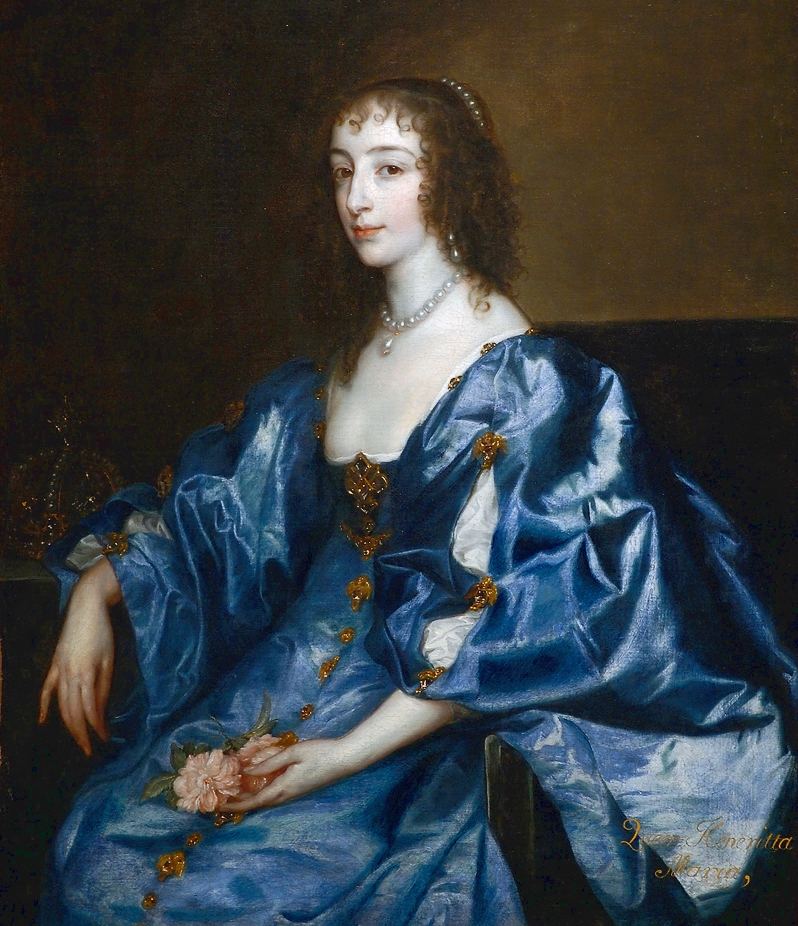
Anthony van Dyck, Portrait of Henrietta Maria de Bourbon, Queen of England, c. 1636-8. San Diego Museum of Art.

While it is possible that the queen’s drawers were the result of French influence on her wardrobe (she was after all a French princess), there is also evidence that non-royalty wore these undergarments around the same time too.

In 1642, the probate inventory of the widow Elizabeth Burges of St. Nicholas Parish in Bristol recorded

‘one payer of cotten drawers at                 s. j [1 shilling]’[7]

Here cotton likely referred to a woollen fabric rather than cotton-fibre textiles. Whether these drawers belonged to Elizabeth, or another family member such as her husband is unclear.

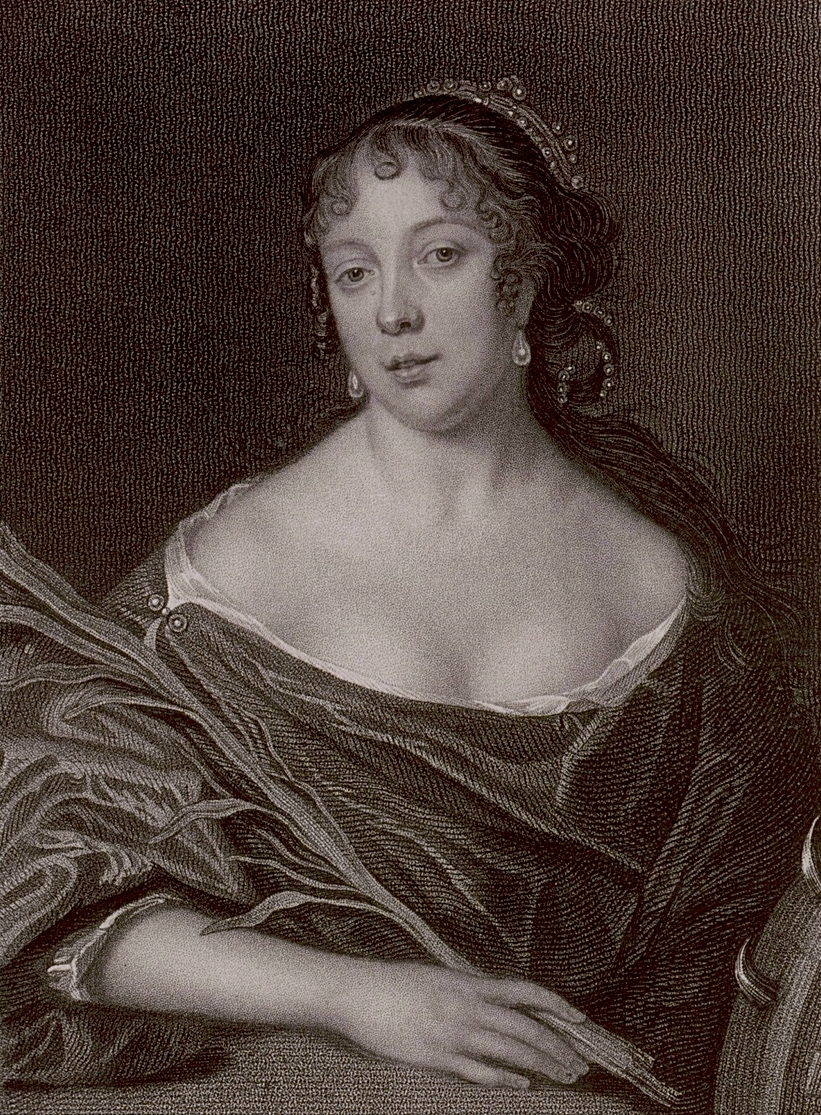
In the 1660s Samuel Pepys made ambiguous references to the morality of his wife Elisabeth’s drawers as he was frequently concerned about whether she wore them when visiting her male dance teacher (who Pepys often suspected she was having an affair with).[8]

He recorded in his diary on the 15 May 1663 that

‘But it is a deadly folly and plague that I bring upon myself to be so jealous and by giving myself such an occasion more than my wife desired of giving her another month’s dancing. Which however shall be ended as soon as I can possibly. But I am ashamed to think what a course I did take by lying to see whether my wife did wear drawers to-day as she used to do, — and other things to raise my suspicion of her, but I found no true cause of doing it’.

James Thomson (engraver), after John Hayls, Elisaebth Pepys, c. 1825 (copy of original seventeenth-century portrait, now destroyed).

On 4 June of that same year, Pepys again wrote that

‘I whiled away the morning up and down while they got themselves ready, and I did so watch to see my wife put on drawers, which poor soul she did, and yet I could not get off my suspicions, she having a mind to go into Fenchurch Street before she went out for good and all with me, which I must needs construe to be to meet Pembleton, when she afterwards told me it was to buy a fan that she had not a mind that I should know of, and I believe it is so’.

Rather than wearing drawers indicating a lack of morals or a proclivity to promiscuity (as it did with Italian courtesans) it appears that Pepys was more concerned with whether his wife might allow her dance teacher easy access to her nether regions by not wearing this garment.

In 1688, the linen draper supplied Queen Catherine of Braganza’s wardrobe with

‘fine frieze holland for drawers for her majesty’.[9]

Although a bill does not survive, presumably it was Catherine’s seamstresses who made these linen drawers up, along with other goods from the linen supplied.

Peter Lely, Portrait of Queen Catherine of Braganza, c. 1663-5. Royal Collection.

Both men and women could wear drawers during the seventeenth century, and tailors and seamstresses made these garments for both genders. It appears that, like North has suggested for the eighteenth century, women likely wore them for warmth or riding. Or as Pepys’ diary entries suggest, even modesty. Or perhaps the comment by Pepys about his wife being a ‘pour soul’ for putting on drawers was because it was summer and the weight of all her skirts would already have been hot. Timing of the queens’ bills suggests that woolen drawers were more common in winter and linen in summer, although a much larger sample would need to be taken to determine this.

Much more research is needed the make firm statements about the history of women’s drawers in the early modern period. As Pat Poppy helpfully points out in her comment below, most of these references relate to Francophile women living in England: Henrietta Maria was a French princess and Elisabeth Pepys’ father was French (her mother was not). Catherine of Braganza’s wardrobe, as my forthcoming book will show, was also heavily influenced by French fashions. So was this a French thing?

I will continue to update this post as I come across references. But what is certain is that drawers were certainly owned and worn by some women in seventeenth century England. How widespread the practice was remains to be determined.

References


[1] Susan North, Sweet and Clean?: Bodies and Clothes in Early Modern England (Oxford: Oxford University Press, 2020), 126-30.

[2] North, Sweet and Clean?, 131-2.

[3] The National Archives UK (TNA), E 351/3145, fol. 25, transcribed and cited in Janet Arnold, ‘The “pair of straight bodies” and “a pair of drawers” dating from 1603 which Clothe the Effigy of Queen Elizabeth I in Westminster Abbey’, Costume, 41 (2007), 9.

[4] Arnold, ‘The “pair of straight bodies”’, 8-9.

[5] TNA: LR 5/64.

[6] TNA: LR 5/67.

[7] Transcribed in Edwin George, Stella George and Peter Fleming, eds., Bristol Probate Inventories, Part 1: 1542-1650 (Bristol Record Society, 2002), 125.

[8] https://www.pepysdiary.com/diary/1663/05/15/#c47569 and https://www.pepysdiary.com/diary/1663/06/04/

[9] TNA: LR 5/83.

17th century, 18th century, Manuscript / Archival Research, Research, Seventeenth-century fashion, Stuart

Second Book Announcement: The Women Who Clothed the Stuart Queens

I’m excited to finally share that I’ve signed a contract with Bloomsbury Visual Arts (an imprint of Bloomsbury Academic) for my next book,

The Women Who Clothed the Stuart Queens: Gender and Work in the Royal Wardrobe and the Fashion Marketplace

The book examines the lives and changing work of the women who made, sold, managed and cared for the clothing of five Stuart queens between 1603–1714: Anna of Denmark, Henrietta Maria, Catherine of Braganza, Queen Mary II and Queen Anne.

Using a wide range of written, visual and material sources, including extensive royal household accounts, this book explores the clothing and fashion cultures of the Stuart period through the lens of the work performed by women (and men!) who worked in the shops of London and the private chambers of the royal household, sitting at the intersection of the fashion marketplace and the royal courts.

In doing so, it recovers the material knowledge and skills of women who clothed these queens. This includes makers and sellers such as seamstresses, silkwomen, tirewomen, mantua-makers and milliners, as well as elite women such as the mistress of the robes and mistress of the sweet coffers, and servants such as laundresses and wardrobe attendants, who worked to manage and care for clothing in Office of the Robes, a sub-department of the Queens’ household.

The book demonstrates that women of all sorts were closely involved in the creation of Stuart magnificence in the fashion marketplace and royal courts of seventeenth-century England and their work was often facilitated by private informal female networks that spanned elite and non-elite structures. This ‘upstairs-downstairs’ history also focuses on under represented periods of fashion history, particularly the period 1680-1715.

I’m really looking forward to getting stuck into writing the rest of the book and looking forward to taking you all on this journey and talking more about my research in both blog and Instagram posts.

17th century, 18th century, Manuscript / Archival Research, Research, Stuart

Quilted Petticoats in the Seventeenth Century

Quilted petticoats in England and America are usually attributed to and discussed in the context of the eighteenth century. This is likely due to the fact that all the earliest surviving quilted petticoats (to my knowledge) date from this period.

Quilted Petticoat, c. 1740-60 (made), 1870-1910 (altered), British. Victoria and Albert Museum, T.430-1967.

I am currently writing a book about the women who made, sold, managed and cared for the clothing of England’s Stuart queens during the period 1603-1714. As I have been transcribing their wardrobe accounts I have come across several references to quilted petticoats.

But firstly, what is a petticoat? The term ‘petticoat’ began to appear in English in the sixteenth century when it was used interchangeably with the preexisting term ‘kirtle’. At this time, and until the mid-seventeenth century, petticoat usually referred to a skirt that had an attached, sleeveless bodice (known as “petticoat bodies”). A petticoat with an attached front lacing bodice is visible in the painting below.

The woman who is standing on the right in this scene is lacing up her petticoat (skirt and attached bodice), which she wears underneath what appears to be a waistcoat (jacket) and jerkin. Frans Francken the Younger, The Witches’ Kitchen, 1606, Hermitage Museum.

By the second half of the seventeenth century, “petticoat” generally began to refer only to the skirt. Petticoats could be under or outer wear. Women often wore many layers of petticoats at this time made from various different materials. This brings me to quilted petticoats in the seventeenth century.

Evidence from the Queens’ Accounts

Did quilted petticoats exist in the seventeenth century?

Yes! They did.

Quilted petticoats begin to appear in the royal accounts after the reign of Henrietta Maria. Unfortunately, the first twenty years of accounts belonging to Catherine of Braganza have not survived. However, those during the 1680s do.

In the Christmas quarter of 1685-6, several “Quilted coats[s]” were made or altered for dowager Queen Catherine of Braganza. At thsi time, the queen’s tailor and dressmakers also provided “new Eaching & Ribanding” for “a Quilted coat” and widened the “Wasts of 3 Quilted Coats.”[1] 

During the early 1700s, Queen Anne was provided with several types of quilted petticoats.[2] These included garments described as “white Quilted under peticoats.” The fabrics that these quilted under petticoats were made from are not mentioned, but if can be assumed that they were some sort of linen, as silks were usually specified in these accounts.

In later periods, quilted petticoats were primarily worn for warmth and this was no different in the late seventeenth century. Even when quilting wasn’t mentioned, wadding of silk, “ferret” and of an unspecified nature (likely wool or cotton) were also frequently listed in Queen Anne’s accounts. For example:

“a scarlet velvet under peticoat _ _ _ _ _ _ _ _ 1-5-0
silk wadding and shaloon _ _ _ _ _ _ _ _ 0-10-6″

Other Evidence

It is likely that the quilted petticoats belonging to Catherine of Braganza and Queen Anne resembled the quilted petticoat belonging to a doll known as Lady Clapham (fig ). The doll portrays fashionable clothing worn by wealthy women during the 1690s and is believed to have belonged to the Cockerell family who had a family home in Clapham, London. This petticoat shows the same sorts of decorative needlework that we see on later eighteenth century examples.

But quilted petticoats were not just common among queens and other elites in England.

In 1688, Thomas Barlow and Oliver Morris of St. Giles’s in the Fields were Indicted for entring the Dwelling-house of John Appleby” and stealing “one Silk Flowred Gown, value 40 s. one Quilted Petticoat, value 10 s. one Crape Petticoat, value 8 s. a pair of Sattin Stayes, value 10 s. and other goods of Ann Thomas.”[3] All these items appear to have been part of an ensemble, the gown was likely a new fashionable mantua gown.

Later, in 1692, Elizabeth Morgan (alias Jones) and Sarah Chandlor were tried for stealing a quilted petticoat from Faith Butler in London too.[4] By 1697, quilted petticoats were also referenced in The provok’d wife a comedy by John Vanbrugh.

These garments therefore appear to have been a relatively common sight by the end of the seventeenth century in places such as London.


References

[1] TNA: LR 5/81

[2] BL: Add MS 61407

[3] https://www.oldbaileyonline.org/browse.jsp?id=t16880113-41&div=t16880113-41&terms=quilted_petticoat#highlight

[4] https://www.oldbaileyonline.org/browse.jsp?id=t16921207-40&div=t16921207-40&terms=quilted_petticoat#highlight

16th century, Armour, Manuscript / Archival Research, Object Research, Research, Research Publications

Fortuna and virtù: Embodying Classical Concepts in Renaissance Armour

The first half of the sixteenth century was a period dominated by repeated conflicts in Europe. The immense amounts of practical and ceremonial arms and armour that these conflicts required fuelled this so-called golden age of armour production seen in key centres of production such as Milan, Augsburg, and Tyrol. During these times of occupation, particularly during the Italian Wars, armourers like the Negroli family of Milan were commissioned to make many garments for princes such as Charles V, and so these items represent elite ideals of power and glory. Although some scholars have claimed that ‘much of the decoration on arms and armour is simply ornamental’, power dynamics and paradoxes between the genders during the Renaissance were exploited in the decorative processes of etching and embossing to personify key ideas such as bravery, perils, fortune, virtue, and victory, in either male or female forms.[i] These representations were deliberately fashioned to make explicit proclamations about power by noblemen on the battlefield and beyond in sixteenth-century Europe. Two concepts that armour during this century embodied in these wats were those of fortune and virtue.

Dirck Volckertsz Coornhert and Cornelis Bos after Maarten van Heemskerck, The Capture of Francis I by the forces of Charles V during the Battle of Pavia in 1525, c. 1555-56. Amsterdam: Rijksmuseum, RP-P-BI-6603.

During the medieval period Fortuna was potrayed an assistant to God and she stood for the decrepitude of worldly things and expressed a hidden, unknowable order that made men and women powerless to chance without faith. However, by the fifteenth century humanists and political theorists who believed that men could take back control began to conceptualise Fortuna as possessing innate feminine weaknesses. Like women, Fortuna was now a fundamentally unknowable, destructive and unpredictable power, but one that could also be influenced or yield to those who fought with force.[ii] To counteract the unpredictability of Fortuna and take back control over destiny, authors began to articulate the concept of virtù, something that was masculine, rational and ultimately victorious.[iii] Although early humanists stressed that virtus (a morally good force) was an intrinsic value for all rulers as it brought glory and greatness, for Niccolò Machiavelli the concept of virtù was not necessarily concerned with ethics.[iv] Rather it was more dynamic and stood for political and military achievements that were the foundation of flourishing states.[v]

Lady Fortuna and the Wheel of Fortune. From an edition of Boccaccio’s “De Casibus Virorum Illustrium” (Paris, 1467) MSS Hunter 371-372 (V.1.8-9). Image (vol. 1: folio 1r). Credit: Wiki

Machiavelli penned his widely circulated work of political philosophy The Prince (1532) in reaction to what he perceived to be the weaknesses of rulers during the Italian Wars. He concluded the work by stating that due to the ‘enormous upheavals that have been observed and are being observed everyday’ it was imperative that men fought to control the whims of Fortuna with ‘ordinata virtù’ (well-ordered virtue) because ‘fortune is a woman, and if you want to keep her under it is necessary to beat her and force her down’.[vi] Machiavelli here echoed the fifteenth-century humanist Aeneas Silvius Piccolomini (Pius II) who after Alfonso V of Aragon’s victory in Naples in the early 1440s imagined the king entering the city and grabbing ‘Fortuna by the scruff of the neck’.[vii] Fortuna’s antithesis Virtù was therefore intrinsically linked to forceful state building and warfare.

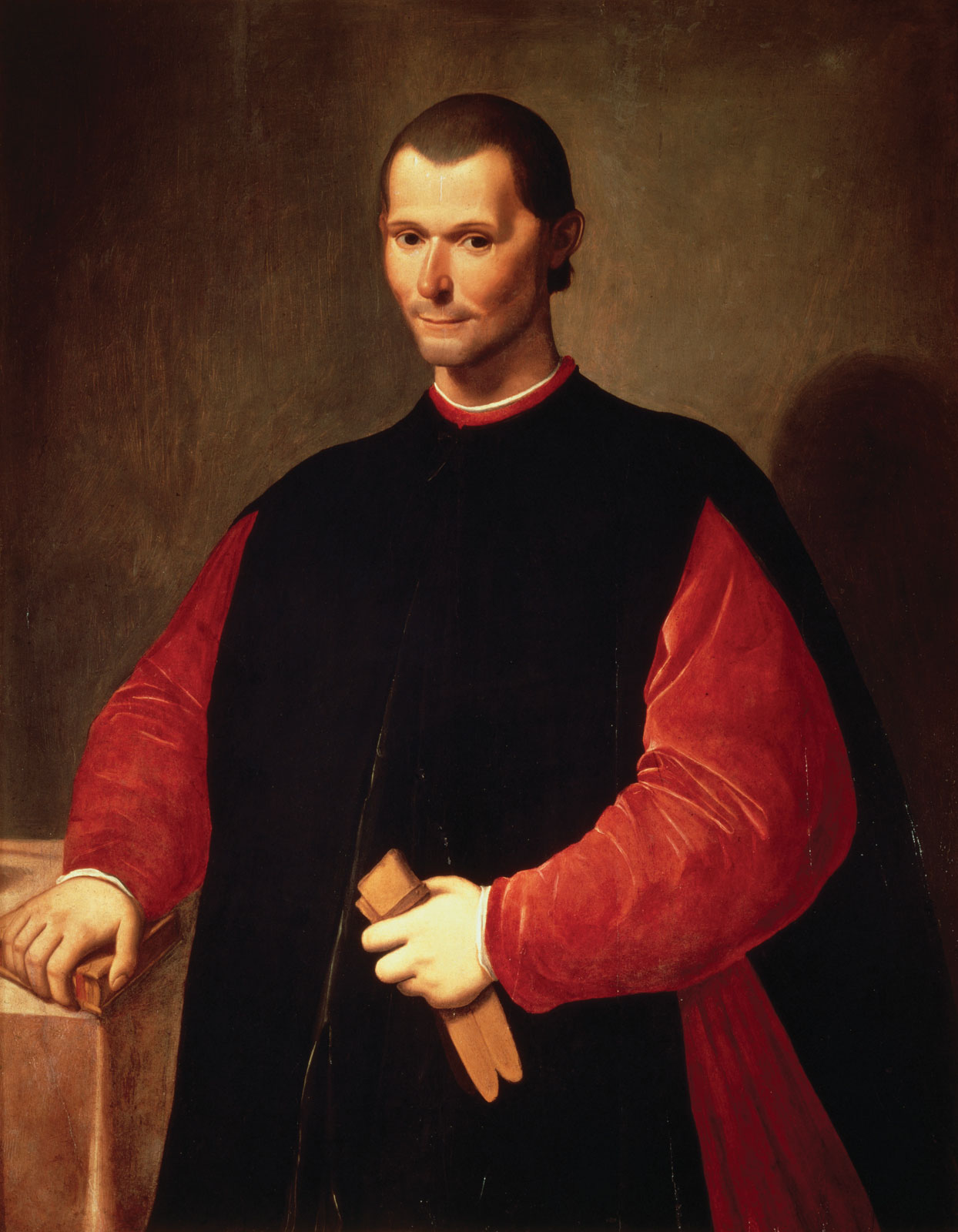
Santi di Tito, Portrait of Niccolò Machiavelli, c. second half of sixteenth century. Palazzo Vecchio. Credit: Wiki

These concepts and their gendered power dynamics were increasingly emphasized in political theory, literature, and art during the turmoil of the Italian Wars. The importance of personifying Fortuna as feminine so that she may be overcome by masculine virtù is best exemplified in a portrait medal of French king Francis I from 1537. One side of the portrait medal depicts the king in profile wearing a laurel wreath and holding a staff with a fleur de lis, proclaiming him ‘Francis King of the French’. The reverse side of the medallion shows the king in armour on horseback, arm raised with sword in hand, trampling the naked female figure of Fortuna. The inscription reads ‘He has vanquished fortune through virtue’.[viii] The portrayal of Francis on horseback defeating fortune through virtue is a statement of the King’s tact as a military leader.

Medallion of Francis I – Bust & Allegory, c. 1537, cast iron, Vienna: Kunsthistorisches Museum, 7272b.

As Machiavelli wrote in The Prince, which had been published only five years earlier, it was a prince who had come to power via virtue (here meaning skill and temperament), rather than fortune, who could maintain his principality, as ‘he who relies less upon Fortune has maintained his position best’.[ix] This gendered juxtaposition was therefore a very clear claim about Francis’s masculinity – he was a courageous and brave prince, who won battles for his Kingdom through his reliance on his masculine traits of virtue such as military skill, rather than relying on the feminine whims of fortune.

Similarly, when the concept of fortune was depicted on armour it was always personified as female to remind the wearer of the potential dangers of relying too much on this feminine force. Take for example a shield in the Royal Armoury in Madrid made in 1543 in Augsburg for Prince Phillip (later Phillip II of Spain) by the armorer Mattheus Frauenpreiss.[x] This round shield portrays the semi-nude figure of a woman (Fortuna) holding an oar while attempting to row the vessel. Around her are the words ‘FIDES’ (faith) on a shield, ‘CARO’ (humanity) on the boat, ‘FORTEGA’ (fortitude) on the oar, and ‘GRACIA DEI’ (by the Grace of God) on a box below her knee. There are two possible interpretations of this shield. La Rocca has argued that fortune is depicted as trying to reverse the direction of humanity with the aid of a steering oar and guided by the shield and compass.[xi] This representation of Fortuna appears to take its cues from the medieval understandings as an assistant to God – with faith fortune can be a guiding force.

Jane Clifford, ‘Shield of Phillip II’, photograph c.1865 (London: Victoria and Albert Museum, 47602). © Victoria and Albert Museum, London

However, as with all visual culture, the meaning of this scene is multivalent and it could also warn of the risks of letting Fortuna have too much control over the ship of humanity, as she is facing towards the stern and so does not have control over its movement. The top of the mast also contains a small fool’s cap making this vessel a ‘metaphorical ship of fools’ that is being steered by the unpredictable force that is Fortuna.[xii] The fools here are perhaps those who place their trust in fortune to lead them, rather than those other items on the vessel like the shield of faith. In either case, as La Rocca has proposed, the ‘overall meaning of the shield’s symbolism seems to be intended as a commentary on the misdirection of human folly’.[xiii] The feminine force of Fortuna was considered to play a key role in guiding human fate and potential folly during conflict. It is possible that this shield was gifted to the young Prince Phillip on his wedding day as a salient reminder to the importance of his union to Maria Manuela of Portugal and his role as prince during these troubled times.[xiv]

This acknowledgement of the place of Fortuna in deciding human destiny accounts for other examples of armour and arms that contain her image. A ceremonial breastplate of worked gilded iron gifted to the future Philip III of Spain by Carlo Emmanuelle, Duke of Savoy, now in the Royal Armoury in Madrid, contains the image of Fortuna is framed by winged genii, Justice, Temperance, and other figures, as well as the word ‘SPANIA’.[xv] The piece was made in Italy in the second half of the sixteenth century by an unknown armourer.

Hans Sebald Beham, Fortuna, c. 1641, engraving. Rijksmuseum Amsterdam, RP-P-OB-10.856

Arms from this period also depict Fortuna. A print with a design for a dagger sheath by Hans Holbein the Younger and Hans Lützelburger dating from 1520-1526 shows a woman (Fortuna) in armour standing on a shell with drapery flowing around her.[xvi] In both these examples the symbolic meaning could be two-fold. Authors like Machiavelli stressed that human actions could only be controlled to an extent by virtù, with the rest remaining the domain of Fortuna.[xvii] Therefore, by personifying fortune as Fortuna on armour and arms this practice served to not only remind the wearer of her dangerous influence and acknowledge the part she played in his fate, but in turn, it would also have had the effect of prompting him to remember her antithesis stressed by humanist authors – his own masculine virtù that could overcome her feminine threat.

Filippo Negroli, Helmet all’Antica, c. 1532–35. This piece was possibly a copy of the original in the Kunsthistorisches Museum Vienna. Metropolitan Museum of Art, New York. 04.3.202.

In contrast to Fortuna, virtù was rendered in anthropomorphic forms that transformed the wearer into the vision of masculinity that this concept represented. This is most recognisable in all’antica-style helmets produced by the Milanese armourer Filippo Negroli for Francesco Maria della Rovere the Duke of Urbino, Charles V, and the Gonzagas of Mantua.[xviii] These helmets are sophisticated examples of how embossed armours could literally fashion their wearer into their desired human form. The earliest helmet of this style was forged in 1532 for the Duke of Urbino. It is a burgonet of blackened steel embossed in high relief that forms a head with curly hair and ear lobes, wearing a diadem of twisted palms.[xix] The purpose of this burgonet was to create the likeness of a Roman youth on the wearer, covering his own physical traits and replacing them with those of youth rendered in steel. However, the helmet soon caught the eye of a much more important and powerful patron, Charles V.

A letter sent from the Duke of Mantua to the Duke of Urbino described the Emperor’s interest in Francesco’s recent commission and urged him to send it to the Emperor for inspection. Charles V was so impressed with Urbino’s anthropomorphic helmet that he commissioned his own. It was presented to him on his official visit to Milan in 1533.[xx] The Emperor’s helmet, however, was quite different in form and meaning than that of Urbino’s. It was a full helmet made in two parts of steel and gold. The burgonet was embossed and chiselled by Negroli to create the head of a classical warrior with gold curly hair and earlobes, wearing a laurel wreath. The detachable buffe (lower face defence) contains an additional full beard, lips, and mouth. It is possible that there was also another missing piece of the helmet that created a mask and concealed the face.[xxi]

Filippo Negroli, Classical Roman Burgonet of Charles V, Milanese, c. 1533. Madrid: Royal Armoury, 10000075 – 10000076, D-1; D-2

While both anthropomorphic helmets created classical masculine heads, the differences in the ways that these helmets were gendered male had great implications for expressions of virtù by these Renaissance rulers. While the Duke of Urbino’s helmet and armour depicts a Roman youth at the cusp of manhood and is without personal insignia, the Emperor’s helmet represented a grown Roman man with a full beard. It contains many details that link it explicitly to Charles V such as a collar of the gold fleece with Burgundian fire steels and flaming flints and Charles’s device of PLVS VLTRA with the columns of Hercules.[xxii]

Anthropomorphic helmets and Cuirasses (joined breastplates and backplates) were also embossed to create well-muscled torsos that alluded to men of the ancient world allowed their wearers to literally embody the qualities of virtus and virtù during the conflicts of the sixteenth century.[xxiii] As Carolyn Springer has noted in her discussion of classically-inspired armour, these cuirasses constructed an idealised vision of the ‘elite male body through the process of prosthetic addition’ and they were a form of exclusively male masquerade that enabled the wearer to disguise his own imperfections to achieve the ‘highest model of proportion and physical beauty’ and to represent himself ‘in a heroic and aggrandized mode’.[xxiv] These helmets and torso pieces concealed the wearer’s true form behind a metal façade, allowing him to literally become a classical Roman Emperor who epitomised these values. As Francesco Petrarca advised Niccolò Acciaiuoli in a letter written in the late fifteenth century, to fight back against Fortuna he must become a conqueror and have the ‘moral qualities of a Caesar’, or in other words ‘a man of true manliness’ like those Caesars of the past would overcome Fortuna and attain public glory.[xxv]

Although Charles V commissioned this piece, there is no evidence to indicate that the Emperor dictated its mature appearance.[xxvi] Rather it appears that this was a shrewd political move on behalf of Negroli and Urbino to portray Charles V as he imagined himself to be. Portrait medals struck between 1520 and 1540 celebrated the Holy Roman Emperor as a modern Caesar as they depict him with a laurel wreath on his head and clad in Roman-style armour surrounded by the text ‘IMP. CAES CAROLVS V AVG’, in direct imitation of roman coins.[xxvii] Therefore, the form that this helmet took, whether dictated by Charles himself or others, allowed the Emperor to take that final step in literally embodying his title of a virtuous Caesar.

Joos Gietleughen, Hubert Goltzius, Gillis Coppens van Diest, Portrait of Charles V as Caesar, c. 1559. Amsterdam: Rijksmuseum, BI-2008-4132-148.

This blog post was adapted from an early version of my new research article ‘Female Personifications and Masculine Forms: Gender, Armour and Allegory in the Habsburg-Valois Conflicts of sixteenth-Century Europe’ in which I explore the use of female personifications on sixteenth-century armour made for men between 1525 and 1550. It argues that foreign invading forces and their allies exploited or inverted traditional gender binaries associated with the classical and humanist iconography of the Italian Renaissance, particularly its female allegorical forms, to visually signify power relationships between combatants during the Italian Wars. Rather than simply embodying masculinity, elaborate ceremonial armours with images of women are revealing of both ideals of masculinity and femininity during times of war. These portrayals were part of wider conversations about gender and power, about the strength and weaknesses of women, and, ultimately, women’s inferior status to men, which were utilised in allegorical forms to make claims to authority on these elite forms of male dress.

You can access the article by clicking here.

This research was supported by an Australian Research Council Discovery grant
(DP180102412) held at The University of Western Australia


References

[i] Donald J. LaRocca, Gods of war: Sacred imagery and the decoration of arms and armor (New York: Metropolitan Museum of Art, 2013), 3.

[ii] Arndt Brendecke and Peter Vogt, ‘The Late Fortuna and the Rise of Modernity’ in The End of Fortuna and the Rise of Modernity, (Berlin: Walter de Gruyter, 2017), 2; Corretti, Cellini’s Perseus and Medusa, 68. 

[iii] Brendecke and Vogt, ‘The Late Fortuna and the Rise of Modernity,’ 1-5.

[iv] Quentin Skinner, Visions of Politics: Volume 2, Renaissance Virtues (Cambridge: Cambridge University Press, 2002), 123.

[v] Friedrich Meinecke, Machiavellism: The Doctrine of Raison d’Etat and Its Place in Modern History, trans. Douglas Scott (New York: Praeger, 1965), 31; Skinner, Visions of Politics, 144, 154-6.

[vi] Niccolò Machiavelli, The Prince, trans. and ed. Peter Bondanella (Oxford: Oxford University Press, 2008), 84-87.

[vii] Brendecke and Vogt, ‘The Late Fortuna and the Rise of Modernity,’ 4.

[viii] Medallion of Francis I – Bust & Allegory, c. 1537, cast iron, Vienna: Kunsthistorisches Museum, 7272b.

[ix] Machiavelli, The Prince, 21.

[x] Donald J. LaRocca, ‘Monsters, Heroes, and Fools: A Survey of Embossed Armor in Germany and Austria, ca. 1475 – ca. 1575,’ A farewell to arms, studies on the history of arms and armour, eds. Gert Groenendijk, Piet de Gryse, Dirk Staat, Heleen Bronder (Legermuseum, 2004), 42.

[xi] LaRocca, ‘Monsters, Heroes, and Fools,’ 42; Carolyn Springer, Armour and Masculinity in the Italian Renaissance (Toronto: University of Toronto Press, 2010), 128.

[xii] LaRocca, ‘Monsters, Heroes, and Fools,’ 42.

[xiii] LaRocca, ‘Monsters, Heroes, and Fools,’ 42.

[xiv] Springer, Armour and Masculinity, 128.

[xv] Albert F. Calvert, Spanish Arms and Amour: Being a Historical and Descriptive Account of the Royal Armoury of Madrid (London: John Lane, The Bodley Head, 1907), 131.

[xvi] Hans Holbein the Younger (artist) and Hans Lützelburger (block cutter), Design for a Dagger Sheath, c. 1520-6, print, London: The British Museum, 1895,0122.841-842.

[xvii] Brendecke and Vogt, ‘The Late Fortuna and the Rise of Modernity,’ 5.

[xviii] Silvio Leydi, ‘A History of the Negroli Family,’ in Heroic Armor of the Italian Renaissance: Filippo Negroli and his Contemporaries, eds. Stuart W. Pyhrr and José-A. Godoy (New York: Metropolitan Museum of Art, 1998), 41; Stuart W. Pyhrr and José-A. Godoy, eds. Heroic Armor of the Italian Renaissance: Filippo Negroli and his Contemporaries (New York: Metropolitan Museum of Art, 1998), 119.

[xix] Pyhrr and Godoy, Heroic Armor of the Italian Renaissance, 116.

[xx] Springer, Armour and Masculinity, 105; Leydi, ‘A History of the Negroli Family,’ 41.

[xxi] Álvaro Soler del Campo, The art of power: Royal armor and portraits from Imperial Spain (Sociedad Estatal para la Acción Cultural Exterior, 2009), 48.

[xxii] Pyhrr and Godoy, Heroic Armor of the Italian Renaissance, 125-130.

[xxiii] Pyhrr and Godoy, Heroic Armor of the Italian Renaissance, 14-15.

[xxiv] Springer, Armour and Masculinity, 11, 25, 30.

[xxv] Peter Stacey, Roman Monarchy and the Renaissance Prince (Cambridge: Cambridge University Press, 2007), 143; Skinner, Visions of Politics, 123, 125.

[xxvi] Springer, Armour and Masculinity, 105-106.

[xxvii] Joos Gietleughen, Portrait of Charles V, c. 1559, print, 17.9 x 17.8cm. Amsterdam: Rijksmuseum, BI-2008-4132-148.